RAID 10 with 8 disks — RAID 10 8-drive configuration, performance & best practices
RAID 10, combining mirroring and striping, offers enhanced performance and data redundancy. In a configuration with 8 disks, RAID 10 ensures both speed and fault tolerance. This article details the setup, examines the performance benefits and challenges, and provides guidelines for efficient rebuilds and best practices, optimizing your RAID 10 implementation.
Executive Summary — Key Recommendation
When configuring RAID 10 with 8 drives, the decision on how to set up the array can significantly impact performance, rebuild complexity, and failure isolation. Here's a detailed breakdown of the recommended configurations for different scenarios:
Single RAID 10 Array (4 Mirrors Striped)
- Performance: A single RAID 10 array with 4 mirrored pairs (striped) takes full advantage of all 8 drives, maximizing both read and write speeds. The striping across the mirrored pairs means that data can be simultaneously read from, and written to, multiple disks, thereby significantly boosting throughput and efficiency. This configuration is especially beneficial for applications requiring high IOPS, such as database servers and virtual machines.
- Rebuild Simplicity: In the event of a drive failure, the single RAID 10 setup simplifies the rebuild process. Only the failed drive needs to be replaced and rebuilt, reducing downtime. Since data is mirrored, recovery consists of duplicating a single drive's data, which is straightforward and minimizes risk.
Two Independent 4-Drive RAID 10 Arrays
- Failure Isolation: By dividing the 8 drives into two separate RAID 10 arrays, the configuration enhances failure isolation. A failure in one array doesn't affect the other, potentially increasing the overall reliability of the system. This setup is advantageous in environments where separate data pools are necessary, such as in multi-tenant systems where distinct data sets need physical isolation.
- Complexity in Capacity Use: While improved isolation is a benefit, this setup leads to more complexity in terms of capacity use and management. The storage resources are divided, and balancing load and storage space between the arrays requires careful planning and monitoring to prevent underutilization or bottlenecks.
Recommended Use-Cases
- Virtualization and High-IOPS Workloads: For applications demanding high input/output operations per second, such as those running virtual machines or database applications, a single 8-drive RAID 10 array is generally recommended to leverage maximum performance and simplify the management of the array.
- Multi-Tenant Isolation: If there is a necessity for separate pools due to security, policy compliance, or tenant isolation in a multi-tenant environment, multiple RAID 10 arrays can be configured, albeit with an awareness of the trade-offs in storage efficiency and maintenance complexity.
Quick Takeaways — One-Line Answers
- How many disks needed: RAID 10 requires a minimum of 4 disks; 8 drives create 4 mirrored pairs striped, enhancing IOPS.
- Capacity overhead (8 drives): Usable capacity is approximately 50% of the total, utilizing 4 times the drive size.
- Rebuild behavior: Rebuilds entail copying mirrors, with rebuild time per-mirror, usually quicker than parity RAID.
- How to set up RAID 10.
What RAID 10 with 8 Disks Means — Topology & Options
Single RAID 10 (One Vdev): 4 Mirror Pairs Striped (Recommended)
In a single RAID 10 configuration with 8 disks, the drives are organized into 4 pairs. Each pair acts as a mirror, with one drive constantly backing up the other. By striping these mirrored pairs, data is distributed across all pairs, which significantly enhances read and write speeds. This setup maximizes input/output operations per second (IOPS), offering a balance of speed and data protection.
- Failure Tolerance: This arrangement can withstand a single disk failure per mirrored pair—up to 4 simultaneous failures are tolerable as long as no pair loses all its members. This architecture provides robust data redundancy without complex recovery procedures, making it a preferred choice for demanding environments.
- Performance: With data spread across multiple disks and mirrors, this configuration excels in read-heavy and write-heavy workloads, providing consistency and minimizing latency in access speeds.
Two RAID 10 Arrays (Two 4-Drive RAID 10s)
This topology splits the 8 disks into two distinct RAID 10 arrays, each with 4 drives. Each array operates independently, allowing for isolated failure domains. When one array encounters a failure, the other remains unaffected, ensuring higher data availability and minimizing systemic risks.
- Isolation: This setup is advantageous where separating data pools is necessary, such as in organizational structures where department-specific data must be isolated for compliance or security reasons.
- Management Complexity: Although offering better failure isolation, this arrangement demands careful load balancing and monitoring. The divided capacity can make it harder to optimize storage utilization compared to a unified RAID configuration.
- Trade-Offs: The community often debates the trade-off between enhanced data redundancy and the complexity involved in managing multiple RAID sets. Each array's separate management necessitates deeper administrative involvement to maintain peak efficiency.
Alternative: RAID 1 Across All 8 (Full Mirror Set)
An 8-way full mirror configuration offers unmatched data redundancy. Here, every piece of data is written to all 8 drives, ensuring that up to 7 disks can fail without data loss.
- Extreme Redundancy: This setup is designed for scenarios where data safety is the absolute priority, such as financial or highly sensitive projects, allowing for continued data integrity even in severe failure situations.
- Usable Capacity: The major downside is that the usable capacity amounts to just one drive's storage out of the 8, resulting in significant storage inefficiency. This makes the configuration impractical for most use cases, except where data safety is critical above all other factors.
Capacity & usable space — 8-drive math
| 📦 Metric | Value (8 × D) |
| Raw capacity | 8 × D |
| Usable capacity (RAID10) | 4 × D (≈50%) |
| Overhead | 50% overhead (mirrors) |
| Hot spare option | Reserve 1 drive → usable 3 × D if hot spare used |
Performance — Random & Sequential I/O with 8 Drives
Random Read Performance
- In a RAID 10 configuration with 8 drives, random read performance is significantly enhanced by the combination of multiple spindles and mirrored pairs. The use of 4 mirrored pairs allows for simultaneous read operations across the array. Each mirror can independently serve read requests, resulting in a substantial increase in random read IOPS (Input/Output Operations Per Second). This setup is particularly beneficial for applications with read-heavy workloads, such as databases, where fast access to small chunks of data across diverse locations on the disk is critical.
Random Write Performance
- Random write performance in RAID 10 is optimized by the architecture's inherent advantages. Unlike parity-based RAID levels, RAID 10 bypasses the overhead associated with parity calculations, reducing latency. Writes are directed to the mirror pairs, which simultaneously process the write operations. The absence of parity calculations means that random-write latency is minimized, and performance scales well with both stripe width and the capabilities of the RAID controller and any additional cache. This makes RAID 10 a solid choice for applications requiring rapid random-write capabilities, such as transaction processing systems.
Sequential Throughput
- The sequential I/O performance of an 8-drive RAID 10 configuration excels due to its striping mechanism across the four mirrored sets. This design yields high sequential bandwidth, as data can be read from and written to multiple spindles concurrently. In environments utilizing NVMe or SSDs, the benefits become even more pronounced, with near-linear throughput improvements up until the point where the RAID controller or storage fabric limits are reached. This makes RAID 10 a highly effective solution for workloads requiring sustained high-throughput performance, such as video editing or streaming applications.
RAID 10 8-drive vs RAID 10 4-drive — direct comparison
| ⚖️ Metric | RAID10 (8 drives) | RAID10 (4 drives) |
| Usable capacity | 4×D | 2×D |
| Max read IOPS | Higher (more mirrors) | Lower |
| Max write throughput | Higher (wider striping) | Lower |
| Fault tolerance (spread risk) | More tolerant overall (depends on distribution) | Simpler failure model |
| Rebuild concurrency | Multiple mirrors can rebuild in parallel | Fewer rebuilds in parallel |
Rebuild Time & Failure Tolerance with 8 Disks
Typical Rebuild Model
In a RAID 10 configuration with 8 disks, the rebuild process is efficient because it operates on a per-mirror pair basis. When a drive fails, only its mirrored partner is used to restore the lost data by copying the contents onto a replacement drive. This targeted approach keeps both the I/O load and the time required for the rebuild lower than what would be needed for RAID configurations that employ full-parity resynchronizations.
- Factors Affecting Rebuild Time: The speed of the drives, the amount of data that needs to be rebuilt, and any throttling mechanisms imposed by the RAID controller are the key factors influencing the rebuild duration. Faster drives and lower occupancy reduce rebuild time, allowing the system to return to a fully redundant state more quickly.
Failure Combinations Tolerated
RAID 10 is designed to tolerate up to one disk failure per mirror pair. Below are some relevant failure scenarios and considerations:
- Maximum Failures: In an 8-disk configuration, RAID 10 can handle up to four simultaneous disk failures, provided they occur in different mirror pairs.
- Worst-Case Scenario: The most dangerous case for RAID 10 is two disk failures within the same mirror pair. Such a scenario results in data loss because there is no surviving copy of the data.
- Minimizing Risk: To reduce the risk of correlated failures, it is advisable to plan the physical mapping of mirror pairs carefully. Distributing mirror pairs across different backplanes or drive bays helps mitigate the chance of simultaneous failures caused by shared hardware vulnerabilities or environmental factors.
RAID 10 SSD vs HDD with 8 Disks
SSD (SATA/SAS NVMe) Considerations
Utilizing SSDs in a RAID 10 configuration offers distinct advantages over traditional HDDs due to their inherent technology:
- Lower Latency and Higher IOPS: SSDs, especially those with SATA, SAS, or NVMe interfaces, deliver significantly lower latency and superior IOPS (input/output operations per second). This results in rapid data access and swift execution of read and write operations, which are particularly beneficial for applications demanding high-speed data processing.
- Fast Rebuilds: The higher throughput and speed of SSDs allow for quicker rebuilds. The time required to restore data to a new drive after a failure is minimized, reducing vulnerability to additional failures during the rebuild process.
- Endurance Considerations: While SSDs excel in performance, their endurance, measured in TBW (terabytes written), is a critical factor. It's vital to select enterprise-rated SSDs with an endurance rating suited to the specific workload demands to ensure longevity and reliability.
HDD Considerations
HDDs still play a vital role in RAID configurations, particularly where cost per gigabyte is a concern:
- Higher Rebuild Risk: HDDs exhibit longer rebuild times due to slower data transfer rates compared to SSDs. This extended rebuild window increases the risk of additional failures during the process, which can compromise data integrity.
- Faster Mirror Rebuilds: In environments utilizing HDDs, RAID 10's advantage over parity RAID is emphasized through the use of mirroring. This setup allows for quicker rebuilds than configurations requiring parity calculation, which is beneficial in mitigating the risks of prolonged rebuild operations.
- Exposure to UREs: Unrecoverable Read Errors (UREs) pose a threat during the extended rebuild times typical of HDDs. RAID 10 provides a degree of mitigation through its mirrored design, which reduces the likelihood of such errors impacting data recovery efforts.
RAID 10 Capacity Overhead with 8 Disks — Planning Examples
Understanding the capacity overhead in RAID 10 configurations is crucial for effective storage planning. Here's a detailed example to illustrate this:
Example: 8 × 4 TB Drives
- Total Raw Capacity: With 8 drives, each having a capacity of 4 TB, the total raw capacity is 8×4,TB=32,TB.
- Usable Capacity: In RAID 10, the usable capacity is approximately half of the total raw capacity due to mirroring. Therefore, the usable capacity is ≈16,TB.
Additional Considerations
- Filesystem and Reserved Space: When planning storage, it's important to account for the overhead introduced by the filesystem and any reserved space required by the operating system. This overhead can reduce the usable space available for data storage further.
- Over-Provisioning for SSDs: If using SSDs, it's advisable to consider over-provisioning space, which involves setting aside a portion of the SSD's capacity to improve performance and endurance. Over-provisioning helps manage wear leveling and extend the lifespan of the SSDs, but it further reduces the space available for data storage.
RAID 10 Benefits and Drawbacks (8-Drive Focus)
Benefits
- Excellent Mixed I/O Performance: RAID 10 offers robust performance for both read and write operations, leveraging both striping and mirroring. This makes it ideal for systems with diverse and demanding I/O profiles.
- Fast Rebuilds: Utilizing mirroring, RAID 10 ensures rapid rebuilds as only the failed disk's mirror is involved in the recovery process. This minimizes downtime and swiftly restores redundancy.
- Predictable Latency and Simple Failure Semantics: The absence of parity calculations results in predictable latency during operations. Additionally, the failure model is straightforward—data remains accessible as long as at least one disk in each mirrored pair is operational.
Drawbacks
- 50% Capacity Overhead: Since half of the storage is used for mirroring, the actual usable capacity is reduced to approximately 50% of the total raw capacity. This can be a significant factor in environments where storage needs are high.
- Vulnerability to Mirror Pair Failures: If multiple disks fail within the same mirrored pair, data loss occurs. This necessitates careful monitoring and maintenance to ensure drive health.
- Requires Careful Physical/Slot/Power Distribution: To optimize reliability and minimize correlated failures, careful planning of physical drive placement, slot allocation, and power supply management is required. Proper distribution helps mitigate the risk of simultaneous failures due to shared infrastructure vulnerabilities.
RAID 10 8-Drive Best Practices
Pair Mapping & Failure Domain Minimization
To enhance reliability and minimize the risk of correlated failures, it's essential to map mirrored pairs across different physical components. This includes:
- Separate Backplanes: Distributing mirror pairs across multiple backplanes reduces the risk of a single-point failure due to backplane issues.
- Different Controllers: Utilizing separate controllers for mirror pairs can prevent controller-related failures from affecting both disks in a pair.
- Distinct Power Domains: Ensuring that mirrored pairs are connected to separate power supplies minimizes the impact of a power failure affecting multiple drives simultaneously.
Use Enterprise Drives & Match Firmware
Selecting the right drives and maintaining consistency across the array is crucial:
- Enterprise-Rated Drives: These are designed for high reliability and endurance, providing better performance under continuous, demanding operations.
- Matching Models & Firmware: Using identical models with matched firmware helps avoid issues related to timeout mismatches and Time-Limited Error Recovery (TLER) differences, which can cause unnecessary drive dropouts and increase rebuild times.
Controller Choice & Cache
Selecting the right controller is key to optimizing performance and stability:
- Queue Depth Support: Ensure the controller or Host Bus Adapter (HBA) supports adequate queue depths to handle multiple concurrent I/O operations.
- Battery/NV Cache: Safe write-back systems, such as those with battery or non-volatile (NV) cache, safeguard data integrity during power disruptions.
- Stable Rebuild Throttling: Controllers with stable rebuild throttling mechanisms minimize the performance impact of rebuilds and reduce the risk of overwhelming the system during recovery operations.
Monitoring & Scheduled Scrubs
Regular monitoring and maintenance are essential to prevent data loss and ensure optimal performance:
- SMART Monitoring: Continuously monitor SMART (Self-Monitoring, Analysis, and Reporting Technology) data to track drive health and anticipate failures.
- Scheduled Scrubs: Implement periodic scrubbing of all data to detect and correct errors proactively. This process helps maintain data integrity and prevent silent corruption.
- Hot-Spare Policies: Maintain a policy for hot spares to ensure immediate recovery capability. Having standby drives reduces downtime and speeds up the rebuild process when failures occur.
RAID 10 Hot Spare Using 8 Disks — Approaches
Option A: Dedicated Hot Spare
- Configuration: One of the 8 disks is dedicated as a hot spare, automatically taking over when a failure occurs.
- Capacity Impact: This approach reduces the usable capacity to three times the size of the drives (3×D). For example, with 4 TB drives, the usable capacity would be approximately 12 TB.
- Time-to-Rebuild: The dedicated hot spare minimizes the time it takes to start rebuilding, as the spare drive is immediately available to replace the failed one, reducing the window of vulnerability.
- Use-Case Suitability: This option is particularly favored for environments where immediate response to failures is crucial, such as remote or unsupervised hosts. It ensures a rapid recovery process without the need for physical intervention.
Option B: No Dedicated Spare
- Configuration: Instead of a dedicated hot spare, this approach relies on a pool of available spares or quick physical replacement when a drive fails.
- Capacity Advantage: The absence of a dedicated hot spare means that all 8 disks are used to form the RAID 10 array, maximizing usable storage capacity.
- Risk Consideration: This configuration poses a higher risk if there's a delay in replacing a failed drive, as the time-to-rebuild is directly dependent on how quickly a replacement becomes available.
- Community Insight: While maximizing capacity is attractive, guidance generally leans towards having dedicated hot spares, particularly for setups in remote or unsupervised locations, to minimize downtime and protect against potential data loss.
RAID 10 Random Read/Write Performance Metrics (Practical Tuning)
Queue Depth & IO Scheduler Tuning
Optimizing queue depth and the IO scheduler is crucial for achieving high performance in RAID 10 configurations. The optimal settings can vary significantly depending on the type of storage media:
- NVMe Drives: NVMe SSDs can handle a much larger number of parallel operations compared to traditional HDDs. This means higher queue depths can be beneficial to fully utilize the drive's capabilities. Adjust the queue depth based on the workload characteristics to ensure optimal throughput and latency.
- SATA/SAS HDDs: For traditional HDDs, more modest queue depths are typically optimal, as these drives have slower access times and cannot handle as many simultaneous operations. Fine-tuning the IO scheduler to align with the specific workload can also enhance performance.
Stripe Size & Filesystem Alignment
Correctly configuring the stripe size and aligning it to the filesystem is essential for maximizing RAID 10 efficiency:
- Stripe Unit Size: Selecting a stripe size that aligns with the typical I/O operation size is crucial. Common stripe sizes range from 64K to 256K. The right choice depends on the predominant I/O characteristics of your workload—larger stripe sizes may benefit tasks like sequential reads or large file transfers, while smaller stripes might be advantageous for random I/O operations.
- Filesystem Block Size: Ensure the chosen stripe size aligns with the filesystem block size to prevent misalignments that could degrade performance. Proper alignment reduces unnecessary read-modify-write cycles, optimizing throughput.
Cache, NVMe, and CPU Contention
Managing cache settings and CPU resources is crucial for maintaining high performance, particularly with NVMe SSDs:
- NVMe SSDs: With the potential for extremely high throughput, ensure the CPU is capable of servicing the drive's queue depth efficiently without becoming a bottleneck. This might involve balancing CPU resources and optimizing the handling of concurrent I/O tasks.
- HDDs and Cache: For HDDs, focus on tuning the RAID controller's cache settings to improve random I/O performance. Effective use of caching can help absorb bursts of I/O requests and smooth out performance fluctuations.
RAID 10 for Virtualization Servers with 8 Drives
Why RAID 10 Fits Virtualization
Virtualization servers often host multiple virtual machines (VMs) that generate a diverse mix of random I/O operations. RAID 10 is particularly suited to such environments due to the following reasons:
- Low Latency: RAID 10 combines the benefits of disk striping and mirroring, offering lower latency compared to parity-based RAID levels. This is crucial in virtualization, where quick data access can significantly influence VM responsiveness.
- Robust I/O Isolation: The architecture of RAID 10 ensures that IOPS are spread across multiple disks, effectively isolating the performance of VMs. This prevents one VM from monopolizing resources and degrading the performance of others, commonly referred to as the "noisy neighbor" effect.
Layout Examples for Hypervisors
When configuring RAID 10 for use with hypervisors, strategic layout planning can enhance performance and reliability:
- VM Images on RAID 10 Pool: Store VM images on a dedicated RAID 10 array. This setup takes advantage of RAID 10’s high performance for reading and writing, which is essential for the smooth operation of VMs under varying loads.
- Separate Controller/Volume for Logs or Swap: To further mitigate the noisy neighbor effect and ensure consistent performance across VMs, consider placing log files, swap partitions, or other storage-intensive operations on separate controllers or volumes. This segregation can help prevent performance bottlenecks by isolating high I/O operations from critical VM workloads.
RAID Recovery & Safe Recovery Workflow
How Failures Typically Play Out
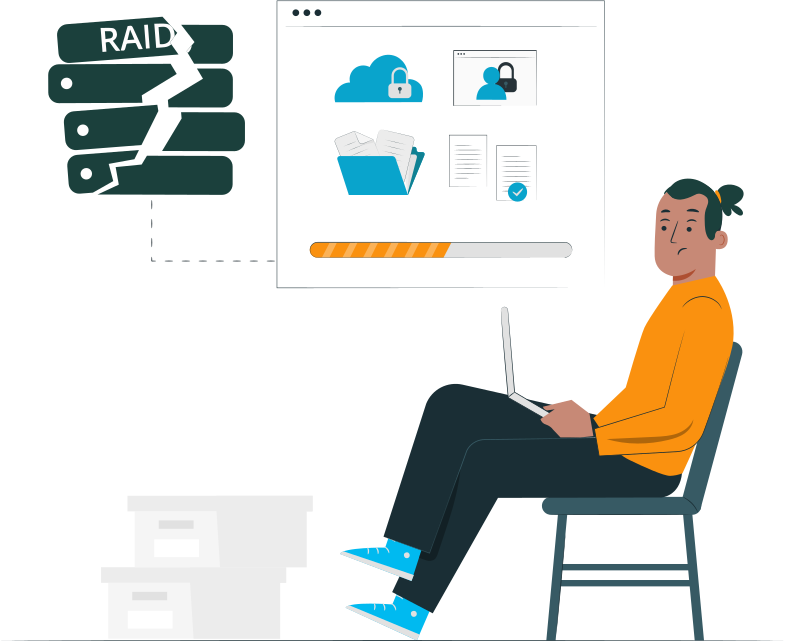
RAID 10 arrays are generally robust, but failures can still occur under several scenarios:
- Controller Failures: A malfunctioning RAID controller can impact data access, rendering the array unreadable.
- Bad Rebuilds: During a rebuild, errors can occur leading to incomplete or corrupted data recovery.
- Accidental Reconfiguration or Metadata Loss: Human errors such as accidental configuration changes or loss of RAID metadata can degrade or make an array unreadable.
Safe Recovery Steps
In the event of a RAID failure, it's crucial to proceed carefully to avoid further data loss. Here’s a recommended safe recovery workflow:
- 1. Stop All Writes: Immediately cease all write operations to the RAID array to prevent further data corruption.
- 2. Image All Member Disks: Create binary images of each disk in the RAID array. This step preserves the current state of the disks and allows for non-destructive recovery attempts.
- 3. Document Disk Order and Controller Metadata: Record the physical order of the disks and any available controller settings or metadata. This information is vital for accurately reconstructing the RAID array.
- 4. Attempt Non-Destructive Reconstruction from Images: Use software tools to reconstruct the RAID array from the disk images. DiskInternals RAID Recovery™ is particularly useful here as it can auto-detect RAID configurations and facilitate recovery.
- 5. Preview Files Before Restore: Before proceeding with restoration, preview the recoverable files to ensure that they are intact and accessible. This step minimizes the risk of data loss during the recovery process.
RAID 10 Recovery Software
DiskInternals RAID Recovery™ free RAID recovery tool offers a robust solution to recover data from a RAID drive:
- Auto-Detection of RAID Layouts: The software can automatically discern RAID configurations, even when controller metadata is missing.
- Reconstruction from Images: It can reconstruct arrays using disk images, preserving the original drives and mitigating the risk of data loss.
- File Preview Before Export: Users can preview recoverable files before committing to the recovery process, ensuring that the data is intact.
Decision matrix — choose your 8-drive RAID10 layout
| Scenario | Best option |
| Max performance, single pool | Single RAID10 (4 pairs) |
| Maximum failure isolation / multi-tenant | Two separate 4-drive RAID10 arrays |
| Max redundancy over capacity | Consider RAID1 across many drives or RAID6 (but write penalty) |
| Remote site / no immediate swap | Considerations for managing without immediate replacement options |
Appendix — Quick Commands & Example Configs
mdadm Example (Create Single 8-Disk RAID 10)
To create a RAID 10 array using mdadm with 8 disks, the following command can be used:
mdadm--create /dev/md0 --level=10 --raid-devices=8 /dev/sd[b-i]1This command initializes a new RAID 10 array on /dev/md0 using the specified devices, /dev/sdb1 through /dev/sdi1.
- Filesystem Creation: Once the RAID array is set up, you can format it with a filesystem of your choice. Here’s an example using XFS:
mkfs.xfs /dev/md0
Adjust the filesystem command (mkfs.xfs) to suit your needs and any specific tuning parameters relevant to your workload.
Monitoring Snippets
For ongoing monitoring and maintenance of your RAID array, these commands can be helpful:
- RAID Details:
mdadm--detail /dev/md0
This command provides detailed information about the status and configuration of the RAID array located at /dev/md0.
- SMART Data:
smartctl -a /dev/sdX
Replace /dev/sdX with the appropriate device identifier to retrieve SMART data, offering vital health and performance statistics for the individual disk.
- I/O Patterns:
iostat -x1Running iostat -x 1 provides extended I/O statistics for all devices, refreshing every second. This is useful for observing I/O patterns and performance metrics in real-time.
Conclusion
In conclusion, RAID 10 offers a compelling balance of performance, redundancy, and simplicity, particularly well-suited for environments that demand high-speed access and robust data protection, such as virtualization servers. By following best practices in configuration and maintenance—such as careful planning of drive layouts, regular monitoring, and adopting a proactive recovery strategy—you can maximize the benefits of a RAID 10 setup.
For administrators, the tools and commands provided offer a practical framework for creating, managing, and troubleshooting RAID 10 arrays. Whether you choose a dedicated hot spare or opt for maximal capacity utilization, understanding the trade-offs and tailoring your strategy to your specific operational needs will ensure resilience and performance.
By remaining vigilant in monitoring drive health and performance, and by using software solutions like DiskInternals for recovery, you can safeguard data integrity and maintain system availability even in the face of hardware failures or other challenges. Ultimately, the key to effective RAID 10 management lies in striking the right balance between capacity, performance, and risk mitigation.