
Understanding RAID Levels: 0, 1, 5, 10, and Data Recovery Strategies
RAID, or Redundant Array of Independent Disks, is a fundamental technology designed to improve data storage reliability and performance. By combining multiple physical disks into a single logical unit, RAID configurations offer various advantages depending on the implemented level. From boosting performance speeds to providing essential data redundancy, RAID plays a crucial role in safeguarding information against hardware failures and optimizing access times.
In this article, we delve into the intricacies of RAID levels 0, 1, 5, and 10, offering insights into their unique benefits and trade-offs. Whether you're seeking enhanced performance, robust data protection, or a balanced approach, understanding these RAID configurations will guide you in selecting the best option for your storage needs.
This guide will break down:
- 📈 Performance characteristics of each RAID level
- 💾 Storage efficiency trade-offs and capacity considerations
- 🛠️ Data recovery implications when drives fail
- 🏢 Best-fit use cases for home users, small businesses, and enterprise environments
Whether your priority is raw speed, robust data protection, or a balanced approach, understanding these RAID configurations will help you select the option that best aligns with your storage needs and operational goals.
Detailed Examination of RAID Levels
RAID 0 (Striping)
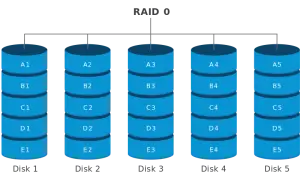
Mechanism:
RAID 0 works by splitting data into blocks and distributing these blocks across two or more disks. This technique, known as striping, allows for parallel processing, where multiple disks can be read or written simultaneously.
Advantages:
- Enhanced Performance: The primary benefit of RAID 0 is its significant boost in data read and write speeds. By leveraging multiple disks to handle data in parallel, RAID 0 can outperform individual drives considerably in terms of throughput. This makes RAID 0 an ideal choice for tasks that require high-speed data access, such as video editing or gaming.
Disadvantages:
- No Redundancy: RAID 0 offers no data redundancy. If one disk in the array fails, all data across the array is lost, as there’s no way to reconstruct the missing information. Thus, RAID 0 should be used in scenarios where data can be easily recovered or is not critical.
RAID 1 (Mirroring)
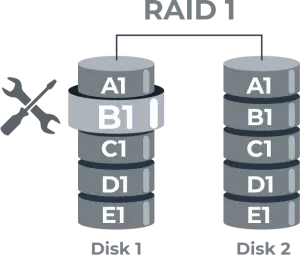
Mechanism:
RAID 1 duplicates data across two or more disks. Each piece of data is copied in real-time onto a mirrored disk, ensuring an immediate backup.
Advantages:
- High Data Redundancy: RAID 1 guarantees that data is protected against disk failures. If one disk fails, the system can continue to operate using the mirrored disk without any data loss, making it suitable for systems where data integrity is crucial.
Disadvantages:
- Halved Storage Capacity: Since all data is duplicated, the available storage capacity is reduced by half. This means that the cost of achieving redundancy is higher, as you effectively need to double the number of disks for the same amount of data storage.
RAID 5 (Striping with Parity)
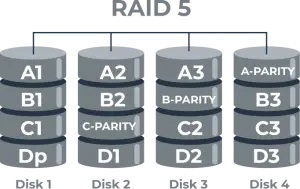
Mechanism:
RAID 5 combines striping and parity, distributing data and parity information across at least three disks. The parity information allows the system to recover lost data in the event of a single disk failure.
Advantages:
- Performance and Redundancy Balance: RAID 5 offers a good mix of performance and redundancy. While it speeds up read operations due to data striping, it also provides redundancy with parity, enabling the system to withstand a single disk failure.
Disadvantages:
- Complex Rebuild Process: When a disk fails in a RAID 5 array, rebuilding the data from the parity information is complex and can take a considerable amount of time. During this rebuild RAID process, system performance may degrade, and additional failures during this time can lead to data loss.
RAID 10 (Combination of RAID 1 and RAID 0)
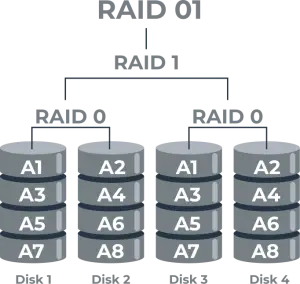
Mechanism:
RAID 10, also known as RAID 1+0, combines the benefits of RAID 1 and RAID 0. It uses both striping and mirroring, requiring a minimum of four disks—two pairs of mirrored disks, which are then striped.
Advantages:
- Superior Performance and Redundancy: RAID 10 delivers both excellent performance and high redundancy. It combines the speedy data access of striping with the reliability of mirroring. This configuration is well-suited for environments that require high availability and quick data access, such as database servers.
Disadvantages:
- High Cost and Reduced Storage Efficiency: Since RAID 10 requires more disks to achieve both mirroring and striping, it is more costly and less storage-efficient than other RAID configurations. You pay a premium for its high performance and reliability, as you need at least twice the number of disks for the amount of usable storage.
| Requirement | Recommended RAID Level |
|---|---|
| Maximum performance | RAID 0 |
| High data redundancy | RAID 1 |
| Balance of performance and redundancy | RAID 5 |
| Optimal performance and redundancy | RAID 10 |
Need to Verify Your RAID Setup?
Use our RAID Calculator to quickly understand your array configuration and find the best recovery approach. It’s simple, accurate, and can save you valuable time before starting data recovery.
Comparative Analysis of RAID Levels
In evaluating different RAID levels, it's essential to consider key parameters such as performance metrics, fault tolerance, and storage efficiency. Here's how RAID 0, 1, 5, and 10 stack up against each other in these areas:
Performance Metrics: Read and Write Speeds
RAID 0:
- Read and Write Speeds: Offers the highest performance among the RAID levels due to data striping. Both read and write operations are considerably faster as they are split across multiple disks.
RAID 1:
- Read Speed: Moderate, as reads can occur from any mirrored disk, potentially offering some speed advantage.
- Write Speed: Slower compared to RAID 0 because the same data must be written to two or more disks.
RAID 5:
- Read Speed: Generally good, benefiting from striping.
- Write Speed: Slower than RAID 0 and RAID 10 due to the overhead of calculating parity.
RAID 10:
- Read and Write Speeds: High performance similar to RAID 0 but slightly less efficient due to mirroring overhead.
Fault Tolerance: Disk Failure Resilience
RAID 0:
- Fault Tolerance: None. A single disk failure results in complete data loss.
RAID 1:
- Fault Tolerance: Excellent. Can withstand the failure of any single disk with no data loss.
RAID 5:
- Fault Tolerance: Good. Can endure the failure of a single disk. However, during the rebuild process, the array is vulnerable to additional disk failures.
RAID 10:
- Fault Tolerance: Superior. Can tolerate multiple disk failures as long as they do not occur in the same mirrored pair.
Storage Efficiency: Usable Capacity vs. Total Disk Space
RAID 0:
- Storage Efficiency: 100%. All disk space is usable since there is no redundancy.
RAID 1:
- Storage Efficiency: 50%. Only half of the total disk space is usable due to mirroring.
RAID 5:
- Storage Efficiency: Typically (N-1)/N, where N is the number of disks. Parity takes up the space equivalent to one disk.
RAID 10:
- Storage Efficiency: 50%. Similar to RAID 1, the efficiency is lowered by the need for mirroring.
| RAID Level | Minimum Disks Required | Data Redundancy | Read Performance | Write Performance | Storage Efficiency | Fault Tolerance |
|---|---|---|---|---|---|---|
| RAID 0 | 2 | No | High | High | 100% | None |
| RAID 1 | 2 | Yes | High | Moderate | 50% | Single disk |
| RAID 5 | 3 | Yes | High | Moderate | (N-1)/N | Single disk |
| RAID 10 | 4 | Yes | High | High | 50% | Multiple disks |
Data Recovery in RAID Systems
Data recovery from RAID 1, 5, 10, 0 arrays poses unique challenges and requires specialized approaches due to the complexity of RAID configurations.
Challenges in Recovering Data from Failed RAID Arrays:
- Complexity of RAID Configurations: Different RAID levels distribute data across disks in unique ways, adding intricacy to the recovery process. Understanding the exact layout and structure is crucial for successful recovery.
- Multiple Disk Failures: RAID arrays can typically handle single-disk failures, but multiple disk failures, especially in arrays like RAID 5, complicate the recovery, often necessitating expert intervention.
- Parity and Rebuild Overheads: Managing parity and rebuilding data using it can be resource-intensive and time-consuming, without guarantees of complete data integrity, especially in degraded or failed arrays.
Importance of Regular Backups and Monitoring:
- Regular Backups: Given the potential for significant data loss, maintaining regular backups of critical data is essential. Backups ensure that data can be restored without reliance on potentially failed RAID systems.
- Monitoring Systems: Proactive monitoring of RAID arrays helps detect anomalies and potential failures early, allowing for preventative maintenance or timely data backup before catastrophic failure occurs.
DiskInternals RAID Recovery™ is a powerful RAID 0 data recovery software designed specifically to address the challenges of data recovery from RAID systems. It supports various RAID levels and offers advanced functionalities for seamless data restoration.
Features and Capabilities
- Wide Compatibility: Supports an extensive range of RAID configurations, including RAID 0, 1, 5, and 10, across various storage interfaces and environments.
- Automatic Detection: The software automatically detects the RAID parameters, minimizing manual input and potential errors.
- Data Integrity Assurance: Employs robust algorithms to reconstruct and recover data with minimal loss, ensuring high data integrity.
Step-by-Step Guide to Recovering Data From RAID Using RAID Recovery™:
- 1. Install and Launch the Software: Begin by installing DiskInternals RAID Recovery™ on your computer and launching the application.
- 2. Choose the Disk to Recover: Select the RAID disk set that you wish to recover from the list of available drives.
- 3. Automatic Detection of RAID Parameters: Allow the software to automatically detect the RAID configuration parameters. If necessary, input any specific details not automatically recognized.
- 4. Initiate the Recovery Process: Start the recovery process. The software will analyze the disks and reconstruct the data structure, beginning the recovery of files.
- 5. Preview and Save Data: Preview the recovered data to confirm the integrity of files. Once satisfied, save the recovered data to a secure location on a different storage medium to prevent overwriting.
Using DiskInternals RAID Recovery™ ensures a systematic and user-friendly approach to dealing with the complexities of RAID data recovery, helping secure and restore valuable information efficiently.
Note: how to rebuild RAID 1 without losing dataConclusion
In this exploration of RAID levels, we have unraveled the complexities and advantages of RAID 0, 1, 5, and 10, each catering to different performance and redundancy requirements. Here's a summary of key points and guidance on selecting the appropriate RAID level:
- RAID 0 offers exceptional performance through data striping but lacks redundancy, making it suitable for non-critical applications that prioritize speed.
- RAID 1 provides high data redundancy by mirroring data across disks, ideal for applications where data reliability is paramount.
- RAID 5 balances performance and redundancy with striping and parity, making it a robust choice for environments needing reasonable fault tolerance and efficient storage. RAID 5 vs RAID 10 comparison.
- RAID 10 combines the benefits of striping and mirroring, delivering optimal performance and redundancy, suited for systems demanding high availability and resilience. More on RAID 10 data recovery here!
When choosing a RAID level, consider your specific needs: whether performance, data security, or storage efficiency takes precedence will guide you in selecting the configuration that best fits your situation.
Moreover, despite the inherent advantages of RAID systems, the importance of comprehensive data recovery solutions cannot be overstated. RAID arrays, though resilient, are not immune to failures, and having robust data recovery strategies—like regular backups and tools such as DiskInternals RAID Recovery™—is crucial for safeguarding your data against potential loss.
In essence, selecting the right RAID level, paired with strategic data recovery planning, ensures a reliable, efficient, and secure data storage infrastructure.
Related articles
- RAID Array for Video Editing: How to Choose
- How to set up RAID 1 on Windows 10 and Linux
- Configuring RAID 5: Step-by-Step Guide on How to Configure RAID 5 for Performance
- How to Rebuild RAID 5 Without Losing Your Data
- RAID 1 Recovery: all you can do yourself
- RAID 5 Data Recovery Step by Step
- RAID Recovery Services
- RAID Recovery Software
- RAID 4 Data Recovery: How to Perform It⠀
- RAID 0 vs RAID 1: Performance, Redundancy & Use Cases
- RAID 5 vs RAID 10 comparison: Which one is better for you?⠀
- How to set up RAID in Windows 10 in 2025
- RAID 5 VS RAID 6 - advantages and disadvantages
- The best NAS RAID: how to choose⠀
- HDD Raid Vs SSD Raid Storage Systems - How to move⠀
- NAS vs External Hard Drive: Comprehensive Guide to Choosing the Best Data Storage Solution
- RAID-1 vs RAID-5: Performance, Cost, and Data Protection Compared
- RAID 10 vs RAID 01: Is There Any Difference?
- RAID vs JBOD: performance and cost comparison⠀
- NAS vs SAN storage - Detailed Comparison⠀
- Perform RAID 50 Data Recovery Today!
- Basic Disks vs Dynamic: What is the Difference
- What Is a Hot Spare? Peculiarities of Usage
- Differences Between Software RAID and Hardware RAID
- How to check RAID status? 4 different methods!
- RAID Array Growing: How to Perform It
- How To Create RAID Arrays with mdadm on Ubuntu (22.04)
- How About RAID 1 Reliability?
- Can RAID array have snapshots?
- RAID Array Metadata: What Is Inside?
- RAID 5: How Big Should an Array Be?
- How Does RAID 5 on Windows 10 Work?
- What is FakeRAID?
- Which RAID is Better to Use for 4 Drives
- Hyper-V Manager - what is it?⠀
- Hyper-V: Generation 1 vs Generation 2
- Hyper-V Live Migration - what is it?⠀
- Hyper-V Snapshot Merge
- About Hyper-V clusters
- Hyper-V network adapters⠀
- Back up Active Directory Guide - Step-by-step Instructions⠀
- Effective Btrfs File Recovery: Complete Guide to Btrfs Data Recovery
- Make Sure Your Data is Safe While Using Microsoft Storage
- Set Up and Use Microsoft SQL Server Management Studio
- Guide: Linux Raid and Disk Data Safety
- Btrfs vs. EXT4: A Comprehensive Comparison of File Systems in Linux (2025)
- RAID Redundancy - best performance solutions⠀
- No hard drive detected or disk controller not supported in RAID
- Issue with the RAID after the BIOS update
- Using SSD in RAID Array
- ZFS Recovery software - How to recover deleted ZFS files
- Raid Recovery Qnap⠀
- RAID recovery software for Mac⠀
- How to Recover RAID Array Configuration
- How to Rebuild RAID Without Losing Data
- How to rebuild RAID 1 without losing data
- How to Rebuild RAID 0 Without Losing Data
- Difference and Comparison - RAID 1 and RAID 2
- Difference between RAID 2 and RAID 3
- Difference between RAID 4 and RAID 5
- What is Synology Hybrid RAID (SHR). How to Recover Data from Synology Hybrid RAID
- Recover Data from RAID on Linux
- RAID Foreign Disk: Causes, Solutions, and Best Practices
- Forensic RAID Recovery
- RAID Data Recovery evaluation. What is RAID data recovery?
- What Is a RAID Controller and What Are the Benefits of It?
- Recover Data from Broken/Failed RAID Set
- How to Clone RAID 0, 1, 5 Disk
- Raid Rebuild Vs. Raid Recovery
- RAID vs. backup - differences and benefits (RAID is not a Backup)
- How to Rebuild RAID array
- What is Synology Hybrid RAID? What is the difference between SHR and RAID Drives?
- Recover Data from RAID 5 on mdadm (Linux)
- RAID Rebuild Time: What is and How to Optimize It?
- RAID Disaster Data Recovery: Techniques and Strategies for Handling Catastrophic Events
- How to Repair a Failed RAID?
- How to Set Up RAID in Windows 11: A Step-by-Step Guide
- RAID 50 vs. RAID 60 – Key Differences
- How to Set Up and Configure RAID 10: Step-by-Step Guide
- What Is RAID 6? Definition, function
- RAID 10 vs RAID 6: Which Better?
- RAID 10: How Many Disks Are Needed and How to Set It Up
- How to recover data from a corrupted RAID?
- RAID 1 with 3 Drives: Everything You Need to Know
- NTFS RAID Recovery: Comprehensive Guide to Data Retrieval
- Comprehensive Guide to RAID in Cyber Security: Levels, Recovery, and Best Practices
- What is software RAID? - Comprehensive Guide
- Understanding RAID 0: Benefits, Risks, and Applications
- RAID 3 Explained: Benefits, Limitations, and Data Recovery Guide
- How Many Drives Are Needed for RAID 5? Minimum & Maximum Explained
- Understanding RAID Striping: A Comprehensive Guide to Disk Striping and Its Variants
- ZFS vs Btrfs vs RAID: Comprehensive Storage Comparison for Performance, Reliability, and Scalability
- How to Resize RAID Partitions: Step-by-Step Guide for RAID 1, 5, 6 & 10
- RAID 1 Minimum Drive Requirement: How Many Drives Do You Need?
- Bootable RAID Recovery Software: Complete Guide for RAID 0, 1, 5, 10 Recovery
- RAID Hard Drives Explained: What Is RAID for HDDs and External Drives
- RAID 5 Rebuild Failure Probability: Risks, Factors, and Solutions in 2025
- Understanding RAID 6 Performance: A Comprehensive Guide
- Recovering Data from RAID Drives: Step-by-Step Guide to RAID Recovery
- Adaptec RAID Recovery: Restore Data from Failed Arrays with DiskInternals RAID Recovery™
- SAN RAID Data Recovery: Recover RAID Arrays with Professional SAN Recovery Solutions
- What is a RAID? RAID Systems Explained & How to Recover RAID Arrays with Professional Tools
- Top 10 RAID Recovery Services: Best Solutions for Data Recovery
- RAID Server Data Recovery: Recover and Restore RAID Arrays Fast with Professional Tools
- RAID System Recovery: Essential Steps & Best Software for Safe Data and File Restoration
- What is RAID Connectivity? Essential Guide to RAID Array Setup
- How Many Drives for RAID 6?
- How to Read RAID Drives & Recover RAID Arrays on Windows: A Guide
- Synology RAID 5 Recovery: Recover Your RAID Array with Expert Tools and Tips
- X-RAID Recovery: Expert Guide to Netgear X-RAID and ReadyNAS Data Recovery
- SCSI RAID Recovery Software: Effective Solutions for SCSI RAID Data Recovery
- RAID Data Recovery for Deleted Arrays: Recover RAID Array Safely & Effectively
- What is RAID in Linux? Learn About Software RAID & Recover RAID Arrays Easily
- Change log for RAID Recovery™
- Intel Matrix RAID Recovery: Restore RAID 0, 1, 5, 10 with Reliable Solutions
- ZFS RAID Expansion: How to Expand RAIDZ and ZFS Pools Safely
- RAID 6 Drive Failure Tolerance: How Many Drives Can Fail?
- Windows Storage Spaces vs RAID: Performance, Speed, and Data Protection Comparison
- RAID 2 Array Explained: What Is RAID Level 2, Setup, and Performance Comparison
- RAID 5 RAID 6 RAID 10 - Key Differences and Performance Comparison
- How to Fix Degraded RAID 1: Step-by-Step Guide to Restore RAID 1 Degraded Arrays
- RAID 5 vs RAID 0+1: Key Differences Explained
- Why RAID 1 Is Not a Good Substitute for a Backup
- How to Check Which RAID Is Configured: A Complete Guide for Windows and Linux
- RAID 50 vs. RAID 6 – Key Differences
- Cannot Format Old RAID Drive? Effective RAID Data Recovery Solutions
- RAID 6 with 5 Drives: Configuration, Performance, and Data Protection
- Best RAID for 6 Disks: Compare RAID 0, 5, 6, 10, 50 & 60 for Performance & Redundancy
- RAID 6 with 8 Drives: Configuration, Failures, and Performance Explained
- RAID 6 with 6 Drives: Performance, Redundancy, and Best Use Cases
- RAID 5 with 5 Drives: Configuration, Performance & Recovery | RAID 5 5 Drives Guide
- 15 Best External Hard Drives for RAID in 2026
- Dell RAID 1 Recovery: How to Recover Data from RAID 1 on Dell Servers Safely
- What Is RAID 1E? Performance RAID 10 1E vs RAID-1E Guide for Power Users
- RAID 1E vs RAID 5: Performance, Capacity and Failure Risk Compared
- RAID 1 Speeds: Read, Write & Disk Performance | Speed Up RAID 1 Guide
- XFS RAID Recovery Guide & Best XFS RAID Recovery Software
- RAID Data Recovery Cost: Affordable Solutions for RAID 0, RAID 1, RAID 5, and RAID 10 Failures
- NAS as a File Server: NAS vs. File Server Comparison for Storage and Sharing
- QNAP RAID 5 Recovery Failed? Safe Data Recovery Steps for NAS Users
- ReiserFS RAID Recovery: How to Restore Data from Failed RAID Arrays
- RAID Calculator For Geeks – Estimate Usable Space & Drive Size
- RAID 0 vs RAID 1 vs RAID 5 vs RAID 10 — Performance, Capacity & Recovery
- RAID 1 vs RAID 5 vs RAID 10 Performance Management, Speed & Capacity Guide
- ZFS Minimum Drives — How Many Disks You Need for RAIDZ1, RAIDZ2, RAIDZ3
- ZFS vs mdadm RAID — Why choose ZFS instead of RAID
- Encrypting RAID Arrays — RAID with Full Disk Encryption & Secure Setup
- Best RAID for OLTP: RAID Configuration for OLTP Workloads & Transactional Databases
- Best RAID for MySQL: RAID Configuration & RAID Setup for MySQL Databases
- Best RAID for NVMeoF: NVMe RAID Configuration & NVMe over Fabrics RAID Setup
- Fault Tolerance in NVMe-oF RAID — Rebuild Time, Data Protection & Redundancy
- RAID 0 vs Single Drive — SSD, NVMe & HDD Comparison (Performance vs Risk)
- RAID 0 vs Single Drive Reliability — Failure Risk, SSD Comparison & Recovery
- RAID 0 vs. SSD Performance: PCIe 4.0, PCIe 5.0 Speed Compared
- Does RAID 0 Increase FPS? — RAID 0 vs Single Drive FPS Guide
- RAID 5 Two-Disk Failure Recovery: Parity Recovery Beyond Tolerance
- Best RAID Controller Guide: Hardware RAID Cards Compared for Servers and SSDs
- RAID Controller for ESXi: VMware ESXi RAID Controller Recommendations
- RAID Controller for Linux: Best Linux-Compatible Hardware RAID Controllers
- SATA RAID Controller for ESXi: VMware ESXi Compatible SATA RAID Options
- RAID Calculator Online – Usable Space & Disk Size Calculator for RAID
- NAS Data Recovery Software & Tools for RAID Recovery
- Features
- RAID 0 Data Recovery
- RAID 10 Recovery
- RAID 6 Data Recovery
- RAID 0, 1, 3, 5, 10 data recovery software for Windows 10
- RAID Reconstructor on Broken RAID Arrays
- The Truth about Recovering RAID 5 with 2 Failed Disks
- SSD benefits for RAID array
- RAID 0 failure - How to Fix Failed Raid 0 Array
- Benefits of RAID arrays - what are the advantages of RAID?⠀
- RAID 3 vs RAID 5: which one would you prefer?
- What are RAID 01, RAID 1+0 and RAID 0+1⠀
- Mdadm RAID 1 not activating a spare disk Linux⠀
- What to do if RAID array doesn't reassemble after reboot
- RAID levels 0, 1, 5, 6, and 10
- Minimum disks for RAID 10⠀
- RAID Consistency Check: Ensure Data Integrity & Recover Lost Data
- Global Hot Spare vs Dedicated Hot Spare: Find the Difference
- What Are Some Common Symptoms of RAID Array Failures?⠀
- RAID status degraded - fix it⠀
- RAID 50 vs RAID 10 - What is the difference
- How to downsize hardware RAID partition and protect data
- What is RAID-Z? Its Difference Between RAID-Z2 vs RAID-Z3
- RAID 6: Replace Two Dead Drives
- Do You Need to Defragment RAID?
- How to Recover RAID partition - step by step guide⠀
- Does chunk size influence the speed of RAID?
- RAID 0, 5, 6, 10 Performance
- RAID Configuration Explained: Types, Setup, and Best Practices
- What Is RAID Redundancy? | RAID Redundancy Explained for Data Protection
- Perform Hyper-V Data Recovery Today
- How to Install Hyper-V in Your Environment in 2025
- Hyper-V Virtual Machine Replication⠀
- Difference Between Type 1 and Type 2 Hypervisor?⠀
- Hyper-V Server Core installation vs GUI - let's compare⠀
- How to Run Linux on a Hyper-V VM in 2025
- What is nutanix ahv?⠀
- What is System Center Virtual Machine Manager⠀
- What is Microsoft SQL Server and How Can You Use it Safely?
- Microsoft SQL Server Express Guide
- Use Microsoft Windows Server Safely
- What to do if you get Microsoft SQL Server error 18456?
- Microsoft Storage Spaces
- Xserve RAID data safety
- Apple RAID Card Data Recovery
- Here is Everything You Need to Know About RAID-Z Technology
- What is JBOD?
- Is it worth using RAID 5E/5EE?
- Let's compare: Synology vs QNAP
- Here is How to Backup RAID in 2025
- Synology RAID Set That Is Broken or Crashed? RAID data recovery
- Here is How to add drive to RAID 5 in 2025
- Best NAS hard drive recovery in 2026 | Top RAID network-attached storage Hard Drives
- SQL Server Database in Recovery Pending - How to fix it (2025)
- RAID Hard Disk Data Recovery Software (2025)
- Best RAID Data Recovery Software for Linux
- Difference between RAID 3 and RAID 4
- Buffalo Data Recovery
- Rapid RAID Recovery Software
- RAID Server Data Recovery
- How to Recover RAID Crash Data
- Raid Drive Array Recovery
- How to Setup Raid 0 Windows 10 (11)?
- How Many Disks Can Fail in RAID 5?
- What is RAID 5? Overview and Key Functions
- How to Remove software RAID device using mdadm
- AHCI vs. RAID: Pros, Cons & Differences
- Recover Data from RAID 1 on mdadm (Linux)
- Difference & Comparison: RAID vs. non-RAID System
- Ultimate Guide to RAID Data Recovery: Tips & Techniques
- Guide to Recovering a Failed RAID Array | Step-by-Step Recovery Process
- Open Source RAID Recovery Software Explained and Comparison
- HDD RAID vs SSD RAID and Combining Both: Everything You Need to Know
- RAID 0: How Many Drives Are Needed?
- RAID 1: How Many Drives Are Needed for Data Redundancy?
- What is RAID 1? RAID Mirroring
- Recovering RAID 5 After Controller Failure
- What is Xserve RAID? Comprehensive Guide and Overview
- Complete Guide to RAID Controller Failure and Recovery: Expert Tips
- Understanding Hardware RAID: Comprehensive Guide to RAID Levels and Benefits
- Understanding RAID 60: Architecture, Advantages, and Data Recovery
- RAID 10: How Many Drives Can Fail? | Comprehensive Guide to Failure Tolerance
- ZFS RAID Setup Guide: Configuration, Management & Expansion
- A Comprehensive Review of RAID Recovery Software: Choosing the Right Tool
- DiskInternals RAID Recovery vs EaseUS Data Recovery Wizard | Comprehensive Comparison
- Comprehensive Guide to ZFS RAID Levels, Types, and Configurations
- ZFS vs RAID: Comprehensive Comparison of Performance, Reliability, and Features
- RAID Drives Explained: Learn How RAID Storage Enhances Performance
- HP RAID Recovery Tool | How to Recover Data with DiskInternals RAID Recovery Software
- Recover Striped RAID: Professional RAID 0 Data Recovery with DiskInternals RAID Recovery™
- BTRFS Restore File: How to Undelete Files and Restore Deleted Data Easily
- Recover Data from a RAID Array: Effective Solutions for Fast and Secure Data Retrieval
- Windows 7 RAID Recovery: How to Recover Data from RAID 1, RAID 5, and RAID 10 Arrays
- What is RAID Data Recovery? | Recover RAID Arrays with RAID Recovery Software
- What is a RAID Volume? Understanding RAID Volumes and Recovery Solutions
- Best RAID Software for Mac | Top Free & Paid RAID Tools for macOS 2026
- RAID Recovery Volume: Effective RAID Array Recovery Solutions for Data Loss Prevention
- Intel RAID 0 Recovery & RAID 1 Recovery: Solutions for Data Loss & Recovery Tools
- Optimize RAID for Redundancy and Performance - Expert Guide
- RAID 0 vs RAID 5: Speed, Performance & Key Differences (2026)
- Synology RAID 1 Recovery: Recover RAID Array with Trusted Tools and Expert Solutions
- Interim Recovery RAID 5: Expert Guide to Data Recovery and RAID Array Repair
- MDADM RAID 0 Recovery: Expert Guide to Fix and Recover Your RAID Array
- RAID Level 4: What Is RAID 4, How It Works
- RAID Restorer – Recover Data from Failed RAID Arrays with Reliable Software
- ZFS RAID with Different Size Drives – Setup, Limitations, and Best Practices
- How to Recover Data from a Broken RAID 1 Set – Step-by-Step Guide
- RAID 50: Drive Failure Tolerance and Data Recovery Solutions
- RAID 5 with 3 Disks: Configuration, Benefits, and Performance Insights
- How to Create RAID 5 with 6 Disks: Complete Setup Guide and Performance Tips
- RAID 6 Double Parity Calculation Explained – Data Protection Insights
- How to Add a Disk to mdadm RAID 5: Step-by-Step Guide
- RAID 0 vs RAID 10 and RAID 10 vs RAID 0 Performance Comparison
- RAID 50 vs. RAID 5 – Performance, Speed, and Data Protection Comparison
- Configure RAID on Ubuntu – Step-by-Step Guide for RAID 0, 1, 5, and 10
- RAID 0 vs. JBOD – Key Differences, Performance, and Speed Comparison
- RAID Array Rebuild: How to Rebuild a RAID Array Safely and Recover Lost Data
- Recover Data from Old RAID Drives | Best Methods & Software for RAID Recovery
- Dell RAID 5 Recovery - Safely and Fast
- RAID 1E vs RAID 10: Performance, Capacity, Cost & Failure Risk Guide
- Ext3 RAID Recovery Guide - Data Recovery RAID Ext3
- ASUS RAID Recovery Guide - Fix Failed ASUS RAID
- ZFS Recovery Tools — Data Recovery ZFS Guide & Best Software
- RAIDZ1 vs RAID 5 — Performance, Integrity & Recovery Comparison
- ZFS Mirror vs RAIDZ — Performance, Capacity & Recovery Guide
- RAID Degraded: What to Do | Warning Fixes and Steps After a Failed Rebuild
- RAID 7 — What It Is? Origins, Risks & Recovery Options
- RAID in Cloud Storage Systems — SDS, Virtual RAID & Erasure Coding Guide
- RAID 10 with 8 Disks — Configuration, Performance, Rebuilds & Best Practices
- Is RAID 0 Worth It in 2026? Risk, Performance, SSD & NVMe Guidance
- Best Practices for RAID over NVMe-oF — Tuning, Monitoring & DR
- RAID 0 for Gaming — Is RAID 0 Good for Gaming? Performance & Risk Guide
- RAID 0 for 4K Editing — Is RAID 0 Good for 4K Video Editing?
- RAID 0 for Large File Workloads: Scratch Disks, NVMe, When It Makes Sense
- Is RAID 0 Obsolete? RAID 0 with SSD and NVMe — Still Worth It?
- RAID 0 Redundancy vs No Redundancy — Does RAID 0 Have Redundancy?
- RAID 5 Interrupted Rebuild Recovery: Fix Stopped or Aborted Rebuilds
- RAID 0 Failure Probability with N Disks Explained
- RAID 1 Corrupted Mirror Recovery: How to Recover a Damaged RAID 1 Mirror
- When RAID 0 Is Acceptable: Use Cases, Risks, and When You Should Use RAID 0
- RAID Best Practices for VMware: Best RAID Configuration for VMware ESXi
- RAID 0 Backed by Versioned Backup: Is RAID 0 Safe with Versioned Backups?
- RAID 10 Best for VMware: Why RAID 10 Is the Recommended RAID for ESXi
- Best PCIe RAID Controller: Top Hardware PCI Express RAID Cards Compared
- SAS RAID Controller for VMware ESXi: Best Hardware RAID Options
- Best FREE RAID Data Recovery Software (2026)
- DiskInternals RAID Recovery vs ReclaiMe: Comprehensive RAID Recovery Solutions Compared