
Fault tolerance in NVMe-oF RAID — Rebuild time for RAID over NVMe-oF & Data protection for NVMe-oF storage
Fault tolerance in NVMe-oF RAID systems is crucial for maintaining data integrity and availability in high-speed storage networks. This article explores the key elements of fault tolerance, including rebuild time, data protection, and redundancy, highlighting their roles in ensuring robust and efficient storage solutions.
Executive Summary — Top-Level Answer
NVMe-oF brings new challenges to RAID by introducing unique failure modes and network considerations. Fault tolerance varies based on where RAID is deployed—either on the host, target, or within software-defined storage (SDS) systems—and is influenced by the design of fabrics, multipathing, and placement domains. Rebuild times in NVMe-oF environments may be shorter than those in traditional HDD arrays, but this is contingent on network capacity, parallel processing capabilities, and drive speeds. To optimize performance, it is essential to plan for redundancy, implement parallel rebuilds, and use fabric-aware throttling strategies.
Key Takeaways — Immediate Guidance
- Position RAID at the layer—such as SDS or the target—that allows for effective control over failure domains, and ensure fabric path redundancy through multipathing to mitigate single points of failure.
- Choose mirrors or dual-parity setups like RAID6 or RAIDZ2 for NVMe pools when minimizing rebuild windows and Unrecoverable Read Error (URE) risks are essential; consider utilizing erasure coding to enhance protection across racks or regions while maintaining storage efficiency.
- Conduct rebuild tests under realistic fabric loads and implement throttling to safeguard foreground I/O. It's crucial to monitor rebuild throughput and error rates, in addition to focusing on completion time.
How NVMe-oF Changes the Fault-Tolerance Equation
Fabric as Part of the Failure Domain
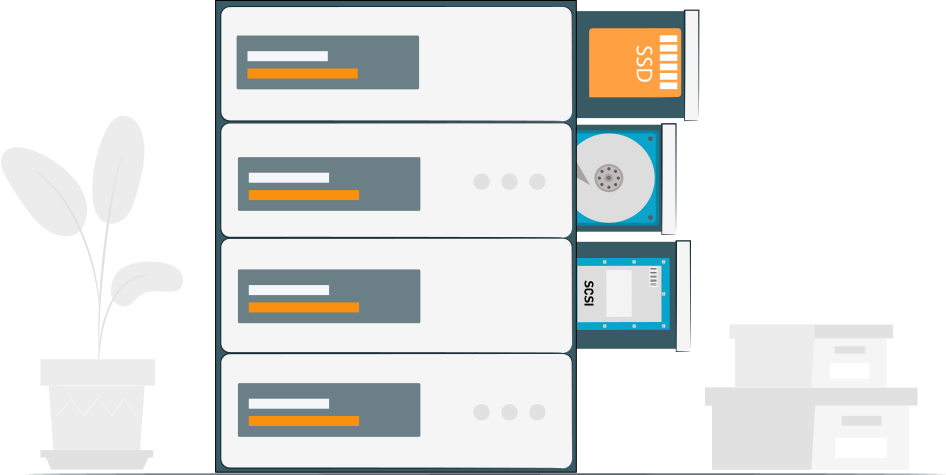
In traditional storage environments, fault tolerance often centers around individual device failures. However, NVMe-oF introduces a more complex landscape where the network fabric itself becomes a critical component of the failure domain. The loss of a network path, target node, or switch in an NVMe-oF setup can be misconstrued as a device failure because these elements are integral to data transmission. This calls for the implementation of multipathing to ensure data has multiple routes to reach its destination, thereby reducing the risk of single points of failure. Additionally, careful placement policies are needed to distribute data and workloads in a manner that minimizes the potential for correlated outages, where multiple failures occur due to a single network component's issue.
Higher Device Throughput → Different Rebuild Dynamics
NVMe devices are renowned for their high throughput capabilities, allowing them to perform rebuilds more quickly than traditional hard drives. However, this increased speed comes with new challenges. Network saturation can occur if the fabric cannot handle the increased data flow during a rebuild, leading to throttled speeds. Similarly, target CPUs might become a bottleneck if they are not equipped to manage the higher data processing demands of NVMe devices. Therefore, successful rebuild planning must extend beyond assessing disk speed; it must incorporate a holistic view of the entire data path. This includes ensuring adequate end-to-end bandwidth and optimizing CPU resources at target nodes to accommodate the high data rates characteristic of NVMe drives.
Fault Tolerance Models for NVMe-oF RAID
Host-Side RAID (Host RAID Engines)
- Pros: Host-side RAID offers low latency advantages for local applications and grants full control over the RAID configurations. This setup is particularly advantageous for single-tenant environments where low latency is crucial to application performance.
- Cons: It presents challenges like limited visibility across multiple targets and difficulties in coordinating multipath failover. These limitations can complicate the management of network failures and recovery processes across different NVMe-oF components.
Target-Side RAID (Array/Controller on Target Nodes)
- Pros: This approach provides centralized rebuild capabilities, often with the benefit of hardware acceleration or Storage Class Memory (SCS) cards, enhancing performance. It also offers a unified view for clients using multipath configurations, simplifying network management.
- Cons: The downside includes potential vendor lock-in due to reliance on specific hardware and controller configurations. Additionally, there is a dependency on controller metadata, which can affect flexibility and adaptability in mixed environments.
SDS & Virtual RAID (Software-Defined Storage Layer)
- Pros: Software-defined storage adds advanced features such as cluster-aware data placement, erasure coding, and cross-node rebuild capabilities. It also allows for granular policy controls over failure domains, offering robust fault tolerance and storage efficiency.
- Cons: Introducing an additional software layer can add complexity and introduce latency, potentially affecting performance. This model is ideal for environments where advanced features and flexibility are prioritized over raw speed.
Rebuild Time for RAID over NVMe-oF — What Drives Duration
Primary Factors
The efficiency and speed of RAID rebuilds in NVMe-oF environments are governed by several interrelated factors:
- Raw Device Bandwidth: NVMe drives are known for their high throughput and rapid access speeds, which significantly contribute to faster rebuild times compared to traditional storage media. However, the actual performance hinges on how effectively the system can exploit this raw bandwidth.
- Fabric Bandwidth and Congestion: The network fabric is a critical component in NVMe-oF systems, serving as the data conduit between storage and compute resources. The available bandwidth and any congestion can become bottlenecks, affecting the speed and efficiency of data transfers during rebuilds. Any saturation in the network can slow down rebuild processes, despite the high speeds of NVMe drives.
- CPU and Target-Side I/O Processing: The computational capacity at the target nodes, particularly the CPU’s ability to handle input/output (I/O) operations, is crucial. Rebuild processes involve significant I/O tasks that demand substantial processing power. An underpowered CPU or insufficient I/O processing capabilities can throttle the potential rebuild speed, causing delays.
- Parallelization Across Multiple Targets: Effective rebuild strategies often involve distributing the workload across multiple nodes or targets. By parallelizing the operations, systems can reduce rebuild times significantly, leveraging the collective bandwidth and processing power available across the network.
Practical Estimates & Scaling
In scenarios involving local PCIe and NVMe arrays, rebuild operations can range from mere minutes to several hours, depending on two primary variables: the size of the data being rebuilt and the free bandwidth available. For NVMe-oF setups, estimating rebuild time requires considering both device speed and parallelism versus the capacity of the network fabric. A practical formula often used is: $\min(\text{device_speed} \times \text{parallelism}, \text{fabric_capacity})$. These estimates should be validated with lab tests to simulate actual operational conditions, factoring in potential real-world variations that could impact performance.
Why Rebuild Speed Alone is Insufficient
While rapid rebuilds are desirable to minimize downtime, they can inadvertently increase the risk of errors. Stressing multiple drives simultaneously during fast rebuilds can lead to additional failures, exacerbating potential data loss scenarios. A safer and more strategic approach involves adopting redundant, resilient designs, such as dual-parity RAID configurations or erasure coding. These methods not only enhance fault tolerance but also allow for controlled rebuild processes. By throttling rebuilds intelligently, systems can safeguard application Service Level Agreements (SLAs), balancing speed with stability and reliability. This approach ultimately mitigates the risk of cascading failures, ensuring data integrity and system longevity in dynamic environments.
Data Protection Strategies in NVMe-oF Environments

Mirroring (RAID-1 / RAID10)
- Mirroring offers a straightforward approach to data protection with low rebuild complexity and predictable latency, making it an ideal choice for latency-sensitive volumes. This method involves creating exact copies of data on separate drives, ensuring that if one drive fails, the data remains accessible. In NVMe-oF environments, it's prudent to use multipathing and distribute mirrors across different failure domains to enhance resilience and reduce the risk of simultaneous failures affecting all mirrors.
Parity RAID (RAID5/6) & Dual Parity
- Parity RAID configurations, like RAID5 and RAID6, use parity information to offer data protection with lower storage overhead compared to mirroring. However, they involve more complex rebuild processes and increased I/O demands during recovery. RAID6 or RAIDZ2 is particularly recommended for large NVMe capacities, as they provide additional fault tolerance and can survive multiple concurrent drive failures. This makes them suitable for environments where large datasets are stored and reliability is critical.
Erasure Coding (EC) at Object/Cluster Layer
- Erasure coding provides high durability with minimal space overhead by reconstructing data fragments from multiple nodes, making it ideal for cross-rack or cross-region deployments. This network-heavy approach efficiently distributes data and its protections across a cluster, allowing for robust data safety even if several nodes or drives fail. Although more demanding in terms of network resources, erasure coding excels in environments that require high capacity efficiency, such as global or object storage systems.
Hybrid Models
- Combining local mirrors for frequently accessed "hot" data with erasure-coded "cold" data tiers can offer a balanced approach to data management and protection. Software-defined storage (SDS) solutions that support policy-based placement and tiering can facilitate this hybrid model, optimizing both performance and cost-efficiency by tailoring data protection and access patterns according to specific needs. This strategy allows organizations to capitalize on the strengths of both mirroring and erasure coding while addressing varying performance and capacity demands.
Redundancy Strategies and Placement Policies
Design Rules for Placement Domains
- Establishing clear design rules for placement domains is essential for robust redundancy strategies. This involves defining specific failure domains at various levels, such as node, chassis, rack, and fabric. By strategically placing mirror or stripe members across these distinct domains, you can significantly mitigate the risk of correlated failures that could result from a single point of impact. In software-defined storage (SDS) environments, leveraging placement groups (PGs) allows for automated and efficient management of these complex configurations, ensuring that data replicas or stripes are optimally distributed.
Multipath & Reservations
- Implementing multipath configurations and setting up path reservations are crucial for maintaining data access and connectivity. These measures help prevent single-path outages by providing alternative routes for data to traverse the network. Utilizing NVMe-specific features, such as reservations and multipath capabilities, enhances system resilience by ensuring continuous access to data even during controller or node failovers. This strategy is particularly important in NVMe-oF environments, where maintaining uninterrupted service is critical.
Throttling and I/O-Aware Rebuild Policies
- Managing rebuild processes effectively requires careful consideration of application workloads and Service Level Agreements (SLAs). By throttling rebuild activities to remain below a predefined I/O target, you can prevent rebuild operations from degrading application performance. Adaptive rebuild strategies that dynamically adjust speeds based on current load conditions can further optimize this process, speeding up rebuilds when the system is less busy and slowing them down during peak usage. This approach keeps applications running smoothly, ensuring that performance SLAs are consistently met while maintaining robust redundancy and fault tolerance.
Operational Runbook — Testing, Monitoring & Recovery

Test Plan Before Production
To ensure robust fault tolerance and recovery processes, it's critical to conduct comprehensive testing prior to deploying NVMe-oF systems in a production environment. Key elements of the test plan should include:
- Simulating Device Failure, Path Failure, and Target Loss: These simulations help identify any vulnerabilities within the system and assess how well the fault tolerance measures respond to different failure scenarios.
- Measuring Rebuild Time and Application Impact: Evaluate how quickly the system can recover from failures and examine the degree to which application performance is affected during the rebuild process.
- Verifying Alerts: Ensure that all alerts and notification mechanisms are functioning correctly to provide timely information about system status and any anomalies.
Monitoring Signals to Track
Effective monitoring is crucial for maintaining the health and performance of NVMe-oF environments. Key performance indicators and signals to track include:
- Rebuild Throughput (GB/s): Monitor the speed at which data is rebuilt to ensure it aligns with expected performance metrics.
- Fabric Utilization: Keep an eye on network congestion and bandwidth usage to proactively address potential bottlenecks.
- SMART/ECC Errors: Regularly check storage device health indicators, such as SMART (Self-Monitoring, Analysis, and Reporting Technology) data and Error-Correcting Code (ECC) errors, to identify early signs of potential failures.
- Latency Percentiles: Analyze latency distributions to detect any deviations from expected performance levels, which can indicate underlying issues.
- CPU Usage on Target Nodes: Monitor CPU utilization to ensure that processing power is not becoming a bottleneck during data operations, particularly during rebuilds.
Recovery Workflow & Escalation
Developing a clear recovery procedure is essential for minimizing downtime and data loss:
- 1. Imaging Affected NVMe Namespaces: If possible, create images of the affected namespaces to preserve data before attempting recovery.
- 2. Collecting Logs: Gather all relevant logs to inform the recovery process and aid in troubleshooting.
- 3. Non-Destructive Logic Reconstructions: Attempt logical reconstructions of the data before resorting to more invasive procedures, helping to preserve data integrity.
- 4. Controlled Rebuilds: If logical reconstruction isn't successful, initiate controlled rebuilds to restore data.
- 5. Escalation to Vendor or Lab: In cases of physical failures, escalate the issue to the hardware vendor or a specialized lab for further investigation and resolution.
- 6. DiskInternals-Style Software-First Checks: Use software solutions to perform initial checks on metadata and array reconstruction, especially when there is suspicion of controller metadata corruption. This can offer a quick assessment and potential fixes before pursuing more extensive hardware-based solutions.
Comparison table — protection options for NVMe-oF
| 🔎 Option | Protection domain | Space efficiency | Rebuild load | Best for |
| Mirror (RAID1/10) | Node / chassis | Low | Low (fast per-mirror copy) | Low-latency DBs, metadata |
| Parity RAID (RAID6) | Node group | Medium | High | Capacity with resilience |
| Erasure coding (k/n) | Cross-rack / region | High | Network-heavy | Object stores, cold data |
| SDS local + EC global | Multi-tier | High | Tunable | Mixed hot/cold workloads |
Case Studies & Vendor Signals

High-Speed RAID Cards & Software RAID Engines
Recent advancements in high-speed RAID cards, such as new SCS (Storage Class Solutions) or SmartRAID cards, are enabling NVMe-capable RAID engines to achieve multi-gigabytes-per-second rebuild rates. These cutting-edge solutions effectively shift the bottleneck from the RAID controllers to the network fabrics and SSD performance. As a result, measuring the system's end-to-end capabilities becomes critical. It's essential to evaluate not only the raw speed of these RAID engines but also how well they integrate and perform within the broader NVMe-oF network environment, considering fabric latency, network throughput, and storage device compatibility.
SDS Examples (Ceph/MinIO) — Policy Controls
In software-defined storage (SDS) solutions like Ceph and MinIO, extensive policy controls are available that greatly influence data protection and performance in NVMe-oF deployments. These platforms offer features like placement groups and erasure coding profiles, providing the flexibility needed to balance rebuild costs against storage efficiency. For example, by adjusting erasure coding parameters, administrators can fine-tune the trade-off between redundancy levels and storage capacity utilization. These capabilities enable organizations to customize their storage solutions based on specific performance and cost requirements while maximizing data resilience across distributed environments.
RAID Recovery Note — NVMe-oF Specifics & DiskInternals Example
In the realm of NVMe-oF storage arrays, the presence of controller and namespace metadata can complicate straightforward recovery processes. When metadata is either lost or when rebuild procedures fail, a diligent, software-first approach is recommended for data recovery. Here’s a strategic step-by-step approach:
- 1. Image Volumes: Begin by creating full images of the affected volumes. This step preserves the current state of the data, safeguarding against further loss during recovery attempts.
- 2. Run Array Detection and Reconstruction Tools: Utilize specialized tools capable of detecting RAID configurations and reconstructing array data from the images. These tools can often identify RAID layouts automatically, which is crucial when metadata is no longer available.
- 3. Preview Files: Before committing to full restoration, preview the reconstructed files to verify their integrity and accessibility. This step helps ensure that the intended recovery actions will restore usable data.
DiskInternals RAID Recovery free RAID recovery tool represents a prime example of such a toolset. It offers capabilities for auto-detecting RAID layouts and aiding in non-destructive reconstruction efforts. By implementing these tools immediately following the imaging step, users can potentially recover data without resorting to destructive measures. Ensuring this non-destructive approach is prioritized provides a blanket of security, particularly when traditional hardware or metadata-oriented recovery steps prove unsuccessful.
Learn more:- RAID rebuild time
- What is a RAID hard drive
- How to set up a RAID drive
- Best hard drives for RAID
- How to rebuild a RAID array
Decision Checklist — Pick a Protection Model (Quick)
- Ultra-Low Latency and Short Rebuilds: Choose Mirrors (RAID1/10) with multipath configurations. This setup is ideal when minimizing latency and ensuring rapid rebuild times are top priorities.
- Capacity Efficiency and Multi-Fault Tolerance Inside a Rack: Opt for RAID6 or RAIDZ2. These configurations are suitable for environments where efficient use of storage capacity and resilience against multiple simultaneous drive failures within a rack are crucial.
- Cross-Rack/Region Durability and Storage Efficiency: Use Erasure Coding at the SDS/Object Layer. This approach is best when the focus is on maintaining data durability across multiple racks or regions while maximizing storage efficiency.
Regardless of the chosen protection model, it is crucial to:
- Validate Fabric Bandwidth: Ensure the network infrastructure can support the intended data transfer speeds and volume.
- Implement Path Redundancy: Establish multipath configurations to maintain connectivity and access during path failures.
- Test Controlled Rebuilds: Conduct trials to verify that rebuild operations do not adversely affect application performance and are completed within acceptable timeframes.