Understanding VMware EVC Mode: Enhancing vMotion Compatibility
Ensuring compatibility and seamless operation across diverse hardware configurations is a pivotal concern for IT administrators. VMware Enhanced vMotion Compatibility (EVC) Mode emerges as a powerful solution in this context, acting as a bridge that harmonizes CPU features across disparate host systems within a cluster. This functionality plays a crucial role in facilitating live migrations of virtual machines (VMs) between hosts with different generations of processors, without disrupting the services they offer.
EVC Mode simplifies the management of mixed hardware environments by standardizing the CPU instruction sets visible to VMs, thereby allowing smooth vMotion and DRS operations across a heterogeneous cluster. This feature is particularly advantageous for organizations that seek to extend the lifecycle of their hardware or gradually phase in newer server models without compromising the performance and reliability of their virtual infrastructure.
In this comprehensive guide, we'll delve into the intricacies of VMware EVC Mode—exploring what it is, unraveling how it works under the hood, and providing a step-by-step walkthrough on enabling it in a vSphere environment. Whether you are a seasoned vSphere administrator or a newcomer looking to optimize your virtual infrastructure, understanding EVC Mode is key to achieving operational efficiency and adaptability in today’s dynamic IT ecosystems.
Introduction to VMware EVC
What is Enhanced vMotion Compatibility (EVC)
VMware Enhanced vMotion Compatibility (EVC) allows virtual machines (VMs) to move between different types of processors without powering them down. This can be extremely useful when performing maintenance on your host servers or migrating your VMs to new hardware.
Purpose and Significance in Virtualized Environments
In virtualized environments, especially those that incorporate a mix of older and newer hardware, maintaining operational flexibility and efficiency is a significant challenge. EVC addresses this by enabling the migration of VMs across hosts without being constrained by the physical differences in CPU architecture. This capability is instrumental for several reasons:
- Operational Flexibility: EVC allows IT administrators to move VMs freely between hosts, facilitating load balancing and maintenance without downtime.
- Extended Hardware Lifecycle: Organizations can continue to utilize older hardware alongside newer systems, gradually phasing in new technology without immediate large-scale investments.
- Improved Resource Utilization: By allowing VMs to migrate without CPU compatibility concerns, resources can be dynamically allocated according to real-time demands, optimizing overall system performance.
How VMware EVC Works
Standardizing CPU Features Across ESXi Hosts
At the heart of VMware EVC is its ability to standardize the CPU features presented to virtual machines across a cluster of ESXi hosts. When EVC is enabled for a cluster, it enforces a common baseline of CPU capabilities by masking certain features that newer processors might possess but older processors lack. This baseline is chosen based on the feature set of the oldest processor in the cluster, ensuring all hosts appear uniform to VMs.
The EVC mode ensures that each VM is only aware of the CPU features guaranteed to be present on all hosts within the cluster. This is achieved through a series of compatibility masks applied at the hypervisor level, hiding non-essential advanced features of the CPUs that exceed the common baseline. Consequently, any VM running in an EVC-enabled cluster can move between hosts without encountering compatibility issues, as it will only utilize CPU features that are universally supported.
Facilitating Seamless vMotion Between Different CPU Generations
One of the primary benefits of EVC is its ability to facilitate seamless vMotion migrations between hosts equipped with different generations of CPUs. Typically, vMotion requires that both the source and target hosts support the same CPU features to maintain VM stability and performance during migration. This requirement can be a significant barrier when managing clusters with mixed hardware.
EVC removes this barrier by allowing VMs to migrate across hosts with varying CPU architectures without encountering errors or needing downtime for compatibility adjustments. By presenting a uniform CPU feature set, vMotion can transfer the state of a VM from one host to another with confidence that the CPU capabilities will remain consistent.
This functionality is particularly beneficial for:
- Maintenance Operations: VMs can be freely migrated off a host requiring maintenance, ensuring continuous availability.
- Dynamic Resource Allocation: Hosts can dynamically balance workloads without compatibility constraints, optimizing performance across the cluster.
- Gradual Hardware Upgrades: Organizations can integrate new server models over time, preserving investment in existing hardware while adopting new technology.
Benefits of Enabling EVC Mode
Increased Flexibility in VM Migrations
One of the standout advantages of enabling EVC Mode is the enhanced flexibility it provides for virtual machine (VM) migrations. In environments with diverse CPU architectures, moving VMs between hosts can be fraught with compatibility issues. EVC alleviates these concerns by creating a consistent CPU feature baseline across all hosts in the cluster, thereby simplifying the migration process. This ensures that VMs can be migrated freely, enabling dynamic load balancing, improved resource utilization, and uninterrupted service availability during maintenance operations.
Simplified Cluster Management
EVC significantly simplifies cluster management by providing a homogeneous CPU environment across a heterogeneous cluster. Administrators no longer need to meticulously match CPU models or manually configure compatibility masks when adding new hosts. Instead, they can focus on other critical aspects of infrastructure management. EVC abstracts the complexity of CPU discrepancies, allowing administrators to maintain clusters with varying hardware seamlessly. This uniformity reduces the risk of human error and enhances the overall stability and performance of the virtual environment.
Extended Hardware Lifecycle
By masking advanced CPU features not uniformly present across all hosts, EVC enables organizations to make full use of their existing hardware for extended periods, even when introducing newer processors into the cluster. This capability allows businesses to phase in hardware upgrades gradually rather than conducting costly, large-scale overhauls. Consequently, EVC helps maximize return on investment (ROI) from existing server resources while facilitating the adoption of modern technologies, supporting a strategic and cost-effective approach to infrastructure management.
VMware EVC Modes and Compatibility
Overview of Available EVC Modes
VMware EVC provides several modes, each corresponding to a different CPU generation from Intel and AMD, allowing for standardization within a cluster. These modes are tailored to various CPU architectures and capabilities, offering baseline compatibility that aligns with different families and models of processors. EVC modes are typically named after specific CPU generations, such as Intel "Nehalem" or AMD "Opteron", representing the specific set of CPU instructions supported. By choosing an EVC mode, administrators can ensure that the cluster presents a uniform feature set compatible with older processors while hiding newer or advanced features that might disrupt migrations.
Determining the Appropriate EVC Mode for Your Cluster
Selecting the appropriate EVC mode is crucial to effectively utilizing this feature. To determine the right mode, administrators should consider the oldest processor's capabilities in the cluster, as the EVC mode sets the baseline that must be supported by all hosts. The chosen mode should correspond to or precede the feature set of the oldest CPU to ensure compatibility across the board. VMware's compatibility guide can assist in identifying which EVC mode aligns with the specific processor families present in the cluster.
Factors such as the specific workloads being run, future upgrade plans, and performance requirements should also be considered when determining the EVC mode. Setting the mode too conservatively might limit available features, whereas setting it too liberally could risk compatibility issues.
Ensuring Compatibility Between Different CPU Architectures
Ensuring compatibility between different CPU architectures is at the core of EVC's functionality. By selecting an appropriate EVC mode, administrators effectively mitigate compatibility issues that can arise during VM migrations between hosts with varying CPU capabilities. The key is to ensure that all features presented in the chosen mode are available on every host's CPU in the cluster.
Before adding a new host to an EVC-enabled cluster, administrators should verify that its CPU supports the EVC baseline set for that cluster. This step involves confirming that the CPU's feature set is compliant with the selected EVC mode, preventing potential migration disruptions. Tools within vSphere can assist in this verification process, helping maintain a stable and compatible environment.
Enhanced vMotion Capability compatibility guide
Compatibility functions for EVC are determined by the model of the old ESXi server processor in the cluster. Typically, older ESXi and vSphere releases support newer processors. However, the maximum EVC baseline remains at the level of older processors that were functional when the particular version of vSphere was released and was then considered the newest.
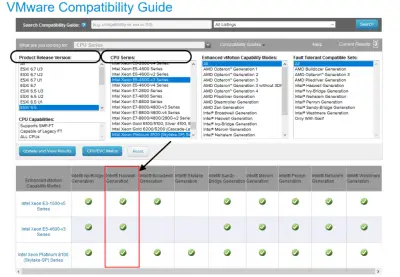
To check the compatibility of your processors and determine the highest possible EVC mode, go to the VMware website and open the VMware Compatibility Guide page. Select the required CPU series and your ESXi version, Next, click the CPU / EVC Matrix button and you will see a table of available EVC modes for your ESXi servers.
Configuring EVC in VMware
So, if you decide to use the mode, then make sure that the following requirements have been met:
- Processors for all ESXi hosts must be Intel or AMD.
- Intel VT-x or AMD-V must be enabled in the UEFI / BIOS of ESXi hosts.
- ESXi hosts must be managed by the same vCenter Server and vMotion must be configured.
Now let's proceed with step-by-step configuration of VMware EVC mode.
- Open VMware vSphere Web Client and go to vCenter.
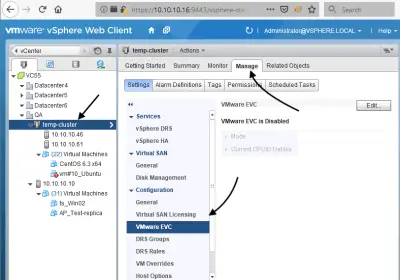
- Next, select the Hosts and Clusters section and select each ESXi host to check the CPU configuration.
- Once the hosts are added to the cluster, select your cluster and click the Manage tab.
- In the "Settings" tab, select "Configuration".
- Click on "VMware EVC" and select "Change".
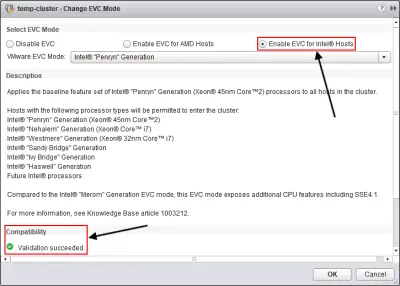
- Click on the button “Enable EVC for Intel Hostsand”, and select “Intel Penryn Generation”. Then save the EVC mode settings.
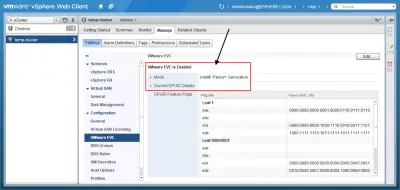
- To see details about registers and mask values, click “Current CPUID Details”.
The easiest way to enable EVC mode is when creating a new cluster. This will reduce the occurrence of problems associated with shutdown and migration of virtual machines that are included in the cluster.
VMware EVC Mode features
CPUID Masking
The CPUID masking feature was created even before EVC. Typically, vCenter compares the CPUID parameters on the virtual machine with the CPUID parameters on the target ESXi host and, if these parameters match, virtual machine migration will be available.
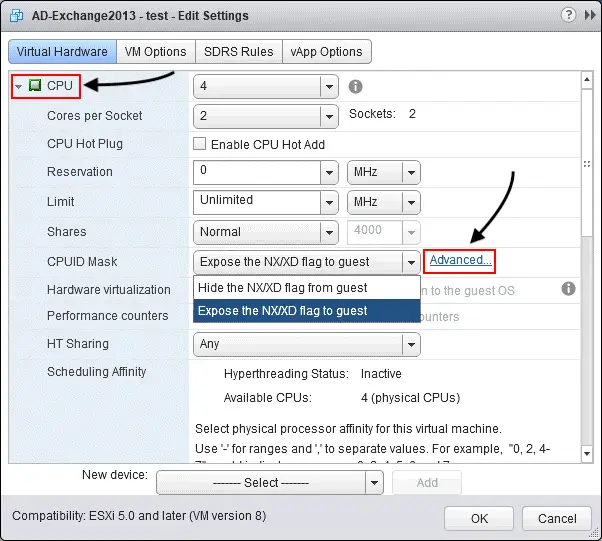
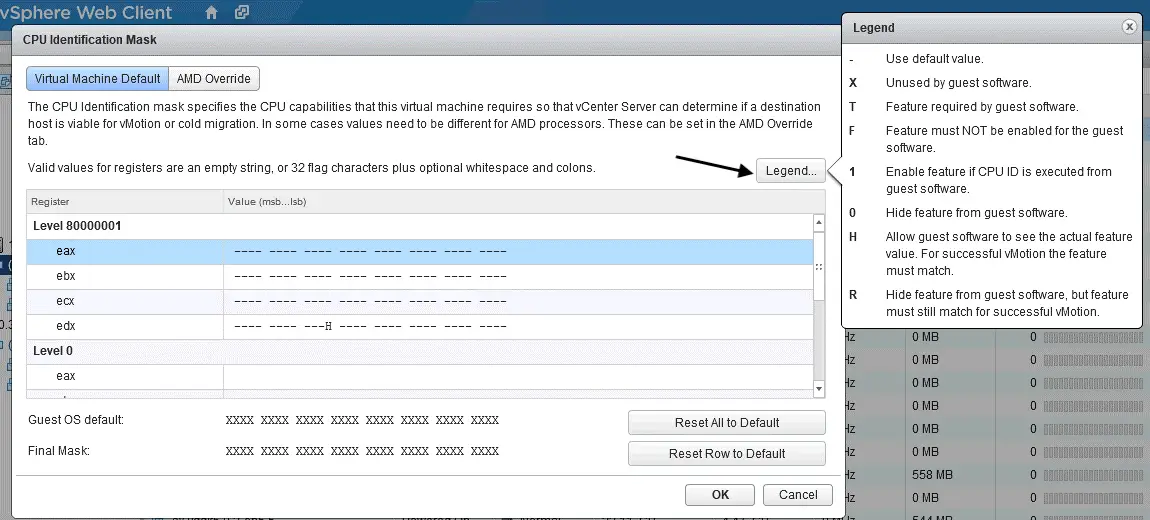
However, be careful with manually editing masks, as this can cause unsupported virtual machine configuration.
Per-VM EVC Mode
Starting with VMware vSphere 6.7, you have the ability to set the EVC mode for each virtual machine. This is quite useful for migrating virtual machines between different clusters or vCenter servers. It also offers a great degree of granularity. In order to use the changed EVC mode settings for each virtual machine, you must turn off and on the virtual machine.
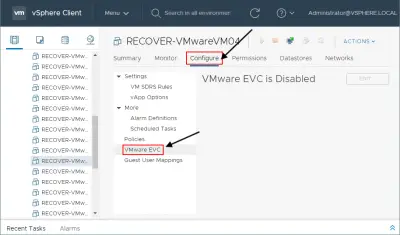
Enabling the EVC Mode in the Cluster without downtime
First, again turn off and then turn on the VM. Without doing this, this procedure will not work.
Also, you must follow certain guidelines:
- Active virtual machines must be on the ESXi host with the oldest processor.
- The EVC mode in the cluster must be configured to use the oldest generation CPU instruction sets.
How to enable Enhanced vMotion Capability Mode
It is recommended to use standard vSwitch (rather than distributed vSwitch). If you do, you will not have any problems connecting the virtual machine with vCenter to the network.
Potential Challenges and Best Practices
Addressing Common Issues When Enabling EVC
While EVC provides numerous benefits in managing mixed hardware environments, enabling it can present certain challenges that need careful attention:
- 1. Incompatible CPU Features: A common issue arises when existing hosts have CPUs that lack some features required by the chosen EVC mode. This can prevent the enabling of EVC until all hosts conform to the selected baseline. To address this, ensure that the EVC mode selected aligns with the capabilities of the oldest host in your cluster.
- 2. Configuration Errors: Configuration mistakes, such as selecting an incorrect EVC mode, can lead to VM startup issues or migration failures. Double-check compatibility with VMware’s documentation and use the compatibility checks within vSphere.
- 3. Performance Degradation: If EVC is set to a mode lower than necessary, it may mask beneficial CPU features, potentially impacting VM performance. Evaluate your cluster’s workloads to ensure the chosen EVC mode meets performance requirements.
- 4. Upgrading CPU Architectures: Introducing new hosts with CPUs that exceed the existing EVC baseline requires careful planning. Evaluate if upgrading the EVC mode might be necessary to incorporate new hardware without compatibility issues.
Recommendations for Maintaining Optimal Performance
To maintain optimal performance while leveraging EVC in your virtual infrastructure, consider the following best practices:
- 1. Thorough Planning and Testing: Before enabling or changing EVC modes, conduct a thorough assessment of your current infrastructure. Use staging environments to test EVC settings and their impact on VMs to avoid disruptions.
- 2. Regularly Review and Update EVC Settings: As hardware in the cluster evolves, periodically reassess the EVC baseline to ensure it continues to meet the needs of your infrastructure. If new hardware is added, evaluate if an EVC mode update is appropriate.
- 3. Monitoring and Performance Analysis: Continuously monitor VM performance post-migration to detect any degradation that might result from EVC masking. Utilize vSphere’s performance monitoring tools to ensure resource allocation remains optimal.
- 4. Documentation and Communication: Maintain clear documentation of the EVC modes and their rationale for all cluster environments. This ensures seamless knowledge transfer and effective communication among team members managing the infrastructure.
- 5. Leverage VMware Support and Resources: Utilize VMware’s support services and online resources for guidance on compatibility and troubleshooting. Engaging with the community can provide insights into best practices and common challenges.
Protecting your data is possible with VMFS Recovery
VMFS Recovery helps protect your data, as it is designed to quickly and correctly read the VMware VMFS file system. This utility returns any files from damaged or healthy disks in VMFS format. This all happens online.

Recovery of VMDK images on ESXi and VMware vSphere servers is also available. The program has a unique VMware Data Recovery Wizard, which, if you need assistance, will ensure uninterrupted operation and extremely positive results. The recovered folders and files can be exported to local or remote locations, including via FTP.
Follow the step-by-step instructions for DiskInternals VMFS Recovery and soon your data will be safe:
- If necessary, make sure that the SSH connection is set up.
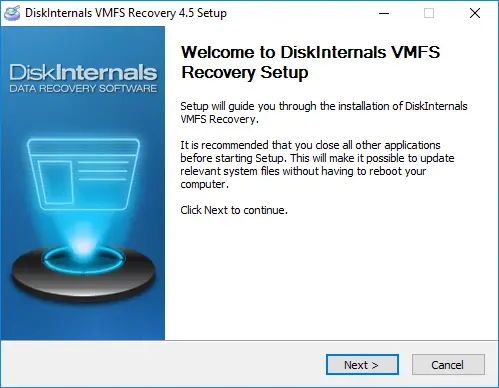
- Download the application and, after installation on a computer with Windows Vista, 7, 8, 10 or Windows Server from 2003 to 2019, run the Recovery Wizard if it does not happen automatically.
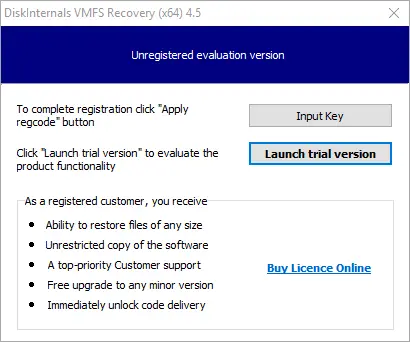
- Open a remote or local drive that will be subjected to a full or quick scan.
- After you've found the VMDK files, mount them and you can open them right away (for free).
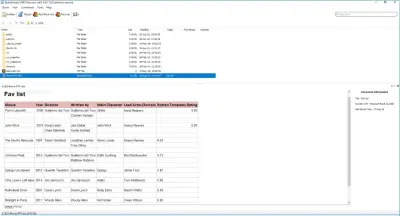
- Now that you are convinced of the results, it's time to click the Buy License button; after that you will receive a unique key with uninterrupted access to the exported data. Learn about vSphere 8.0 recovery here!
Ready to get your data back?
To recover VMware virtual machine (start recovering your data, documents, databases, images, videos, and other files), press the FREE DOWNLOAD button below to get the latest version of DiskInternals VMFS Recovery® and begin the step-by-step recovery process. You can preview all recovered files absolutely for FREE. To check the current prices, please press the Get Prices button. If you need any assistance, please feel free to contact Technical Support. The team is here to help you to open VMDK file and repair VMDK file if required!
Conclusion
In the dynamic realm of virtualized environments, VMware Enhanced vMotion Compatibility (EVC) stands out as a pivotal feature that addresses the intricate challenges of CPU compatibility across mixed hardware clusters. By establishing a uniform CPU feature set, EVC empowers organizations to execute seamless live migrations, thereby enhancing operational flexibility and ensuring uninterrupted service delivery. Its ability to simplify cluster management and extend the lifecycle of existing hardware adds considerable value, facilitating strategic growth and resource optimization.
In recapping the importance of VMware EVC, it becomes evident that its integration is more than a mere technical enhancement—it's a strategic enabler of efficiency and adaptability. With EVC, organizations are better equipped to navigate the complexities of modern IT infrastructure, balancing the benefits of innovation with the practicalities of existing investments.
Therefore, IT administrators and decision-makers are encouraged to implement EVC within their vSphere environments to maximize vMotion compatibility. By doing so, they not only fortify the stability and resilience of their virtual infrastructures but also set the stage for future expansions and upgrades that can be managed with confidence and ease. Embracing EVC is a proactive step toward a more agile and responsive virtualized landscape, ensuring that organizations remain at the forefront of technological advancement while maintaining robust operational capabilities.
FAQ
-
Enhanced vMotion Compatibility (EVC) works by creating a consistent virtual CPU feature set across all hosts within a cluster. It masks the differences between CPU generations, ensuring that all CPUs present the same set of features to the virtual machines. Before allowing vMotion, EVC verifies that the destination host supports all the features exposed by the source host's CPU. Consequently, VMs experience seamless migration without encountering compatibility issues related to processor differences. This provides flexibility in managing and upgrading hardware without interrupting ongoing workloads.
-
VMware's Enhanced vMotion Compatibility (EVC) is confined to working within the same processor architecture, meaning it does not support cross-vendor migrations between Intel and AMD CPUs. Each CPU vendor has distinct feature sets and architectures, making such a transition challenging without causing compatibility issues. EVC is specifically designed to mask differences within the same vendor's CPU generations to maintain a consistent environment for VMs. Therefore, if you need to migrate VMs between Intel and AMD processors, you must consider other strategies beyond EVC. This limitation emphasizes the importance of planning hardware upgrades carefully to maintain compatibility within your environment.
-
To enable EVC in VMware, first ensure all hosts in your cluster are powered down or in maintenance mode. Then, open the vSphere Client, navigate to the cluster settings, and find the "VMware EVC" option. Select "Edit" to configure EVC, choose the appropriate EVC mode for your hosts' CPU vendor (Intel or AMD), and set the required CPU baseline. Once configured, power on your hosts and verify that EVC is active and operational. It's essential to migrate or save VM states before powering down if you plan to enable EVC on an existing cluster.
-
To check the EVC mode of a virtual machine, access the vSphere Client and select the cluster that contains the VM. Navigate to the "VMware EVC" tab within the cluster settings to view the current EVC mode and CPU baseline compatibility level. Additionally, you can examine the VM's summary to confirm its compatibility with the cluster's EVC mode. If needed, you can review the individual VM's settings for further details on its CPU feature set and any specific mode requirements. This process ensures that the VM adheres to the EVC standards set for the cluster.
Related articles
- Migrate VM from ESXi to Proxmox: Complete 2026 Guide
- VMware OVA vs OVF: Key Differences, Use Cases, and Recovery Tips
- KVM vs Docker: Performance, Isolation & When to Use Each
- Convert OVA to Hyper-V: Step-by-Step Guide for Easy Virtual Machine Migration
- Guide to Change VMware ESXi Logs Location
- repair VMDK files in VMware | DiskInternals VMFS Recovery™
- Is VMware virtual machine inaccessible? Fix it in 2025!
- Restore VMware VM with snapshot(delta.vmdk) files⠀
- What is virtualization? | Meaning of virtualization
- What is VMware HA?
- What is the difference between VMware HA vs vMotion
- VMware vMotion storage: What do You Need to Know
- VMware Fault Tolerance: what is it and how does it work?
- What is thin provisioning (TP)?⠀
- What is а LUN? (Logical Unit Number)
- How to Upgrade VMFS from 3 to 5th version
- VMware vMotion vs storage vMotion: all you wanted to know
- VMware Template vs. VMware Clone: the differences and similarities
- VMware Workstation and Its Uses
- VMkernel Ports and Networking Layers
- What is VM Host Server
- What is a Snapshot in VMware⠀
- What is vVol and How Does That Work
- VMware ESXi vs vSphere vs vCenter: Key Differences, Features, and Which to Choose
- What is NVRAM?⠀
- What is a VM Cluster and How to Create It
- Using and Creating VMware Content Library: Features, Setup, and Best Practices
- VirtualBox vs. VMware - Comparison
- No bootable medium found
- Citrix vs VMWare VDI - What are the differences in 2025?
- What is the 3-2-1 backup rule?⠀
- Convert VHD to VMDK - Free Methods
- P2V vs VMware: What is Better for You?
- How to Install Kali Linux VMware
- VMware ESXi Root and Default Password
- What is VMware networking?
- VMware vSwitch
- How to open VMDK files
- VMware NFS vs VMFS
- Hyper-V Nested Virtualization - all about and how to enable⠀
- About VMware home lab
- Install ESXI on USB
- Steps to update VirtualBox
- Install Ubuntu on VirtualBox
- How to remote control an Ubuntu System
- Setting up VirtualBox
- VMware vSphere Replication
- Ways to Fix VirtualBox E_FAIL (0x80004005) Error
- Want to increase VirtualBox disk size?
- VMware Player Shared Folders⠀
- Result code: e_invalidarg (0x80070057)
- Hardware virtualization is enabled
- The best solutions for Virtual Machine in Windows 10, 11
- Here is how to enable virtualization
- Here is everything you should know about GMSA
- VMFS Partition Table Recovery
- Reset a Virtual Machine in VMware
- Free Download VMware Data Recovery Tool
- VMware disk image recovery - 2025 expierence
- How to Repair Damaged VMware Virtual Machine (2025)
- Checking VMDK Disk for Errors (VMDK check tool)
- VMware Data Recovery configuration
- How to Recover Data from Virtual Disk Files
- Disk Mode for the ESXi VM. What is it and how do we use it: VMware
- VMware VMDK Recovery Tool
- Recover VMware virtual machine
- VMware missing VMDK file
- How to Extract Files from VMDK: Best VMDK Extractor Methods
- Fix VMFS Corruption
- How to check VMFS for metadata corruption
- VMware disk needs repair
- DiskInternals VMDK Viewer
- VMware Workstation: The Specified Virtual Disk Needs Repair Fix
- Best VMware Admin Tools: Optimize Performance with Essential Management Tools
- How to Access VMFS Datastore from Linux, ESXi host or Windows
- What Is VMware Data Recovery?
- Download VMware Data Recovery Plug-in by DiskInternals
- How to recover deleted virtual machine in VMware?
- The Best Virtualization Software of 2026: Top Picks and Recovery Tips
- VHD Recovery Software - Recover Corrupt or Deleted VHD Files
- Recover a Deleted VMFS Datastore on VMware ESXi
- How to FSCK VMFS Repair?
- How to Fix DiskPart Virtual Disk Service Errors in DiskPart 2026
- How to Fix VMDK is Corrupted and Cannot be Repaired
- Fix "Virtual Disk Service Error Clean Is Not Allowed”
- VMware vSphere 8.0 - What's New?
- What is VMware ESXi Server?
- VMware Disaster Recovery (DR) Solutions
- VMware Player vs Hyper-V: Performance, Features, and Comparison Chart
- How to create a virtual hard disk (VHD) on Windows
- Restore VMware VMs in Minutes — Fast, Safe & ESXi 8 Ready
- Comparison between HA vs DRS (Distributed Resource Scheduler) in VMware vSphere
- SCSI Controller in VMware: Types, Benefits, and Configuration Tips for Optimal Performance
- VMware Distributed Switch – The Complete Guide
- How to Clone VM in Hyper-V - Best Ways!
- What is VMware Remote Console and how Use it in Linux and Windows?
- VMware ESXi Home Lab: Ultimate Guide to Setup, Configuration, and Best Practices
- Why Is Your VM (Virtual Machine) Running Slow?
- How to Increase VMware Virtual Disk Size and Expand Partition?
- What exactly is VM sprawl, and what steps can be taken to prevent it?
- What Is the VMX File in VMware ESXi?
- Understanding the Differences: VDI vs HVD
- VM Backup vs Snapshot: Key Differences & VMware Best Practices
- Types and Strategies of Backup: Understanding Incremental, Differential, and Full Backups
- What is VMware vCloud Suite - Why Should You Use it?
- How to Create and Use Shared Folders in VirtualBox: A Comprehensive Guide
- Comparing Virtual Disk Formats: VDI, VHD, and VMDK
- How to Mount a VMDK File from Another VM in VMware: Step-by-Step Guide
- Migrating VMFS 5 Datastore to VMFS 6 Datastore: A Step-by-Step Guide
- How to Convert or Migrate Hyper-V to VMware VM
- Exploring Alternatives to VMware ESXi for Virtualization: Top Options in 2026
- Proxmox Backup and Restore: Comprehensive Guide for Efficient Data Management
- Easiest Guide to Copy VHD to Physical Disk Without Data Loss
- How to Disable Hyper-V in Windows 10 and 11: Complete Guide
- How to Restore VMDK to a Physical Drive - Complete Guide
- Mastering VMware Snapshot Recovery: Understanding, Creating, Managing, and Restoring VMs
- Restore VMDK from Backup: Comprehensive Step-by-Step Guide
- Ultimate Guide to Migrating Proxmox VMs to a New Server
- Recover a Deleted Virtual Machine in Proxmox: Step-by-Step Guide
- Virtual Disk Bad Blocks: Detection, Repair, Prevention
- Mount VHD in Windows 7
- VMware Player Snapshots: Limitations, Workarounds, and Best Practices
- What is a Virtual Machine? | Guide to VM Components & Benefits
- What is a VM Server? | Understanding VM Server Architecture & Benefits
- Best VMware Backup Solutions in 2025: Comprehensive Guide and Top Picks
- How to Move VMware VM to Another Host Without vCenter
- VMware DRS (Distributed Resource Scheduler) - What is it?
- How to Convert VHDX to VMDK: Comprehensive Guide with Recovery Tips
- Convert VHDX to VDI: Easy Methods & Data Recovery Insights
- Convert VHD to VHDX: Easy Steps to Convert VHDX to VHD Format
- Convert OVA to VHD | How to Convert VHD to OVA | Step-by-Step Guide to Virtual Machine Conversion
- How to Delete VHDX File in Windows 11 | Step-by-Step Guide + File Recovery Tips
- Mount VHDX Linux: Step-by-Step Guide to Mounting VHD and VHDX Files on Linux Easily
- Free VMFS Reader for Windows, Linux & macOS – Access VMware VMFS Volumes Easily
- Virtual Server Data Recovery: Restore Lost Data from VMware, VMFS, and VMDK Files
- Restore Hyper-V Virtual Machine from VHDX: Quick and Reliable Recovery Guide
- VHD vs VHDX Performance: Key Differences, Benefits, and When to Choose
- How to Resize a VHD File or VHDX
- VDI Meaning: What Is a VDI? Virtual Desktop Infrastructure Explained
- RDM vs VMDK: Key Differences & Performance Insights for VMware Environments
- Convert VHD from Dynamic to Fixed | Easy Guide to Convert Dynamic VHD to Fixed
- Extract VMDK from OVA: Step-by-Step Guide for VMware and Data Recovery
- Recover Deleted VHD Files Easily: Step-by-Step Guide for Successful Recovery
- Nutanix vs VMware: Comprehensive Comparison of Virtualization Platforms
- VMware Disk Types: Thick, Thin, and RDM Explained for Virtual Machine Management
- Change log for VMFS Recovery™
- Nutanix vs AWS: Key Differences, Use Cases, and Choosing the Best Cloud Solution
- Master Proxmox CLI Commands: Your Guide to Virtualization Management and Troubleshooting
- Proxmox Backup Server Setup: Step-by-Step Guide for Configuration
- Proxmox Server Setup: Complete Guide to Install and Configure Proxmox VE
- Proxmox VE Minimum Requirements: Essential Hardware for Optimal Virtualization
- Proxmox NAT Setup: Step-by-Step Guide to Configure NAT & Recover VM Files
- What is a VMware VIB File? Comprehensive Guide to .vib Files and Data Recovery
- Resize VDI - How to Resize VDI Files: Step-by-Step Guide
- Proxmox Backup and Restore: Easily Restore VM from Backup or to a New VM
- VMware Drag and Drop Not Working? Fix Issues in Workstation, Player & Windows 10
- How to Copy Files from VM to Local Machine | VMware File Transfer to Host Guide
- How to Paste in VMware Console | Enable Copy and Paste in VMware Console Guide
- VMware to Nutanix Migration: Step-by-Step Guide for Seamless Transition
- How to Copy ESXi VM and Copy VM from One ESXi Host to Another
- Proxmox vs oVirt: Full Comparison of Virtualization Platforms in 2026
- KVM vs VMware: Performance, Features, Cost & Comparison of Virtualization Platforms
- Open VM Tools vs VMware Tools: Feature, Update & Performance Differences
- OpenStack vs VMware: Cost, Features, Scalability & Virtualization Comparison
- AWS vs VMware: Pricing, Performance & Security | Azure vs VMware Cloud Guide
- QEMU vs VMware: Performance, Features
- QEMU vs VirtualBox vs VMware: Performance, Usability, and Best Use Cases
- Virtualbox vs Hyper-V
- How to SSH Into ESXi Host Securely
- OpenShift vs VMware: Key Differences, Use Cases, and Comparison Guide in 2026
- Dual Boot Linux vs Virtual Machine: Performance, Setup & Recovery Guide
- Compare WSL vs Virtual Machine
- Bootcamp vs Virtual Machine: Windows on Mac Performance & Recovery Guide
- VMware CPU vs Core: CPU, Cores & vCPU Optimization for Virtual Machines
- Kubernetes vs VMware: Key Differences, Use Cases, Cost & Recovery Guide
- Import VMDK to Proxmox: Step-by-Step Proxmox VMDK Import Guide
- Difference Between OVF and VMDK | VMware File Formats Explained
- VMware High Availability vs. Fault Tolerance - Key Differences
- How to Install Windows on Mac VMware Fusion - Windows 10 & 11 Guide
- VMware Delete from Disk vs. Remove from Inventory - Key Differences Explained
- VMware Boot ISO Image: How to Boot from ISO in vSphere and Workstation
- How to Restart a VM Safely | VM Restart Methods and Recovery Guide
- Convert VMDK to VDI VirtualBox | VirtualBox Convert VMDK to VDI Guide
- How to Convert VMDK to VMX
- VMware Converter V2V Conversion Guide: V2V VMware Converter Migration
- VMware Converter to OVF: Fix Unable to Parse OVF File & Export VM
- Oracle DB Create Schema: How to Create Schema in Oracle Database
- What Is Change Block Tracking? VMware CBT, Enable, Reset, CTK Explained
- How to Convert VMDK to VMX | VMDK to VMX Converter and Recovery Guide
- USB Boot in VMware: VM Workstation Boot From USB Guide
- Recover Missed VMDK Descriptor: VMware Repair and VMFS Recovery Guide
- KVM vs LXC: Full Comparison of Performance, Security & Use Cases
- KVM vs QEMU: Architecture, Performance & When to Use Each
- VMX vs VMDK: VMware File Differences, Roles & Recovery
- VMX Configuration File Options: Complete VMware VMX Parameters Reference
- Hardware RAID Enterprise Usage vs Software RAID: Full Guide
- ESXi vs KVM vs Xen: Full Hypervisor Comparison 2026
- LXC vs KVM vs Docker: Full Linux Virtualization Comparison 2026
- KVM vs ESXi: Performance, Cost & Architecture Compared
- KVM vs VirtualBox: Architecture, Features, and Performance Comparison
- Xen vs KVM: Hypervisor Architecture, Performance, and Platform Comparison
- What Is VMFS in VMware: VMFS File System Explained and Features
- Convert VMX to OVF & OVF to VMX: Full Guide with ovftool
- Xen vs KVM vs VirtualBox: Full Hypervisor Comparison 2026
- VMware CPU Cores per Socket Best Practice, Licensing, and Performance
- NSX-T vs NSX-V: Architecture, Features & Migration Guide
- Restarting Management Agents ESXi: All Methods & Safe Guide
- Xen vs. VMware: Hypervisor Comparison — Architecture, Performance & Cost
- VMware Memory Hotplug Linux: Ubuntu, CentOS & Debian Guide
- Install VMware Tools Mac OS: Complete Step-by-Step Guide
- Recover Deleted VHD Xen & Restore Deleted XenServer VM
- Enabling SSH
- How to Fix/Repair Corrupted VMDK Files Effortless
- Mounting Server Disks
- Recover Deleted VMDK from Datastore Today
- Remote Recovery
- VMFS Recovery™ for VMware Data Recovery
- Recover VM from flat VMDK - The Best Solutions
- Restore a VMDK file
- Restore VMware virtual machine from VMDK file
- VMFS Recovery software as a solution for NFS data repair
- What is ESXi Recovery Mode
- What Is Raw Device Mapping (RDM) in VMware? Benefits, Setup, and Use Cases
- VMware ESX vs. ESXi - Main Differences. Detailed Comparison
- VMware vMotion: all you need to know
- How to Clone a VM - Best Steps to Using in VMware
- What is VMware DRS?
- VMFS Block Size: How to Choose
- VMFS UNMAP: What is It?
- What is Space Reclamation and How to Perform It
- Thick vs Thin Provisioning: All You Wanted to Know
- VMware Infrastructure: What Components are Used
- VMware vMotion requirements: for VMs and for hosts
- VMware FT vs VMware HA: what the difference?
- What is VMware VDS and How It Works
- ESX Partitions: All You Wanted to Know
- VMware Cold and Hot Migration: What Is It
- What is Virtual Desktop Infrastructure(VDI)?
- What is VMware vCenter Server and How Does It Works
- How to Manage VMware ESXi
- Manage Hyper-V Integration Services 2026
- Hyper-V Checkpoint and Its Importance for VM
- Hyper-V Export VM: How Does It Work
- ESXi Free Limitations: Pros and Cons
- How to Convert VMware VMs to Hyper-V
- How to set up Hyper-V network adapters - guide
- VMware: Workstation Pro vs Workstation Player
- How To Perform a USB Passthrough in Hyper-V⠀
- What is Hyper-V VDI and Its Benefits
- How to install Kali Linux in VirtualBox⠀
- VHDX Files and How to Mount Them on Windows
- Disaster Recovery Checklist: You Need A Plan
- VMware Network Adapter settings
- VMware snapshot best practices
- Hyper-V Virtual SAN
- Hyper-V NIC Teaming⠀
- The Ultimate Guide to AWS EBS Snapshots: How to Create, Manage, and Optimize Your Snapshots
- How to get full screen in Virtualbox
- About VirtualBox network settings
- How to Install VirtualBox Extension Pack on Windows, Linux & macOS
- Physical Server vs. Virtual Server: Key Differences
- ESXi 7.0 ESXCLI Command Reference in 2025
- How to create a Virtual Machine from a hard drive
- VMware vSphere 7
- Host Profile in VMware - what is and how to use it?
- About VMware vRealize Orchestrator
- Intel VT-x in BIOS: how to enable it?
- VMware Cloud Foundation
- Virtual Desktop Infrastructure and VMware Horizon
- How to Fix DiskPart Virtual Disk Service Errors in 2025 - Best Ways
- Unable to Connect to Virtual Disk Service in Disk Management: Fixes & Solutions
- How to format VMware disk using ESXI
- VMware Data Recovery Software
- Tools to mount VMFS on Linux, ESXi, Windows
- VMware Disk Image: 2025 guide
- VDS fails to claim a disk
- Read VMFS partition on Windows
- How to browse VMDK file
- ESXi repair install
- How to fix a Time Capsule disk in "Internal disk needs repair" status?
- VMware Data Recovery Services
- Repair ESXi datastore
- Restoring The Entire Virtual Machine Whith DiskInternals VMFS Recovery
- VMware VMDK Recovery Tool - Restore VMDK Files
- What Is Backup and Recovery? - Backup vs Recovery
- How to Backup VMware Data. Backup solution for Vmware
- How to restore VHD file backup? (2025)
- How to download VMDK file from datastore to Your System in the VMware
- Diskinternals VMFS Recovery Serial Key
- Virtual Disk Service Error The Object Is Not Found - How to fix?
- How to Backup and Recovery ESXi Virtual Machines?
- How to Backup VMware ESXi Virtual Machines - Back Up ESXi Host Configuration
- How to Recover a VMware Image
- How to Fix ESXi Boot Failure in UEFI Configuration?
- ESXi UEFI booting hits a roadblock, halting at the "VMware Hypervisor Recovery" phase with no further advancement
- Vmware Delete Flat File - Let's Figure It Out
- Diverse Hyper-V Replication and Failover Types
- Repair virtual disk in VDMK
- How to repaire corrupt VMDK header files
- How to recover a corrupt or damaded VMDK file on Mac?
- Mastering VMware Disk Mount: A Comprehensive Guide for Windows 10 Users
- Restore your Lost VMware Files - DiskInternals VMware data recovery
- Difference between VMFS 5 vs VMFS 6
- What is quiescing VMware vSphere?
- How to Recover or Remove Orphaned Virtual Machines
- VMDK file format - What is Virtual Machine Disk format
- How to Install macOS on VMware ESXi or VMware Workstation
- Virtual Machine Disk Consolidation Is Needed: Full Fix Guide
- VMware Horizon Vs VDI by Microsoft - What the difference
- VMware Hypervisor Recovery: Strategies and Best Practices
- Understanding Datastore Inaccessibility in VMware
- Overview and Configuration of USB Passthrough in VMware Virtual Machines
- Convert a VMware Workstation VM to ESXi using 3 Ways
- How to Recover Corrupt VMDK File in VMware
- How to Recover VHDX Files (VHDX recovery)
- Repair VHD - Virtual Hard Disk repair tool
- Migrating VirtualBox VM to Hyper-V - Complete Guide
- Recovering a Virtual Machine in Oracle: Step-by-Step Guide
- What is vApp in VMware? Key Concepts and Usage Examples
- Recovery and Restore of vApp Data: Comprehensive Guide
- VHDX Repair: Comprehensive Guide to Fix Corrupt or Unreadable VHDX Files description
- What is a Virtual Hard Disk (VHD File)?
- Resolving "VMware File Not Found" Errors: Comprehensive Guide to File Recovery
- Comprehensive Guide to VMware File Types and Extensions
- Failed to Read from File VMDK: Causes, Solutions, and Prevention
- Proxmox vs ESXi: Comprehensive Guide to Choosing the Best Hypervisor
- Data Recovery on iSCSI LUN: Comprehensive Guide to Prevent and Recover Data Loss
- How to Mount VHDX Files in Windows 10: A Comprehensive Guide
- What is a VM Snapshot: Comprehensive Guide to Virtual Machine Snapshots
- Unlocking a Locked VM in Proxmox: Step-by-Step Guide to Resolve and Prevent Issues
- How to Mount VHD Files in Windows 10: A Comprehensive Guide
- Comprehensive Guide to Virtual Data Recovery Software | Best Tools & Tips
- Repair-VHD PowerShell: Step-by-Step Guide (3 Essential Steps to Fix VHD)
- How to Restore VHDX File: Step-by-Step Guide for VHDX Restore to HDD, Disk, and More
- How to Open a VHDX File: Extract Data & Recover VHDX Files with Ease
- What is a KVM Virtual Machine? | KVM Virtualization Explained with File Recovery Solutions
- VDI Recovery Software to Restore VM VirtualBox and VDI Files
- Virtual Data Recovery Services
- Xen vs Proxmox - A Comprehensive Comparison
- Best VMware Backup Software and Solutions | Top Backup Options for VMware 2025
- How to Create a VDI from a Hard Drive: Step-by-Step Guide for VirtualBox Users
- How to Convert VMDK to RDM: Step-by-Step Guide for VMware Storage Management
- How to Convert RDM to VMDK in VMware: Step-by-Step Guide
- What Is an RDM? Learn About RDM Storage and Disks in VMware
- How to Backup ESXi Host Configuration: Step-by-Step Guide for VMware Administrators
- VMDK to VHDX: Convert VMDK to VHDX with PowerShell & Tools
- What is Nutanix and How It Works: Discover What Nutanix Does and Its Use Cases
- How to Install VIB on ESXi: ESXCLI Software VIB Install Guide
- How to Install VMware Tools on Ubuntu | Install VMware Tools on Ubuntu 22.04
- How to Install VIB on ESXi: ESXCLI Commands for ESXi VIB Installation
- Proxmox Disaster Recovery: Step-by-Step Guide to Secure Your Virtualized Environment
- Proxmox Backup Server: Comprehensive Guide to Setup and Management
- How to Install Ubuntu Desktop & Server on Proxmox | Step-by-Step VM Installation
- Corrupt VDI File: How to Fix and Recover Virtual Disk Data Effectively
- How to Fix a Corrupted VirtualBox VMDK Compressed Image
- How to Find MAC and IP Address of a Virtual Machine in VMware | VMware MAC & IP Guide
- How to Recover VMDK File: Recover VMware VMDK File and Extract Data from VMDK
- Create VM Template in VMware: Step-by-Step Guide
- How to Recover VMDK File on oVirt
- Docker Meaning, Definition & How It Works: What Docker Is Used for in Software
- Docker vs VMware: Performance, ESXi Comparison, Containers & Key Differences
- oVirt vs KVM: Key Differences, Performance, and Which Virtualization to Choose
- How to Convert VMware to oVirt: Importing VMware VMs to oVirt
- oVirt vs VMware: Compare KVM oVirt vs VMware ESXi for Virtualization in 2026
- OpenStack vs Proxmox VE: Compare Virtualization, Deployment, and VM Recovery
- AWS vs VMware: Pricing, Performance & Hybrid Cloud Comparison
- vSphere vs OpenStack - Full Comparison
- OpenStack vs Nutanix: Key Differences, Use Cases, VM Recovery & Performance Guide
- Migrate oVirt to VMware - Can I Move VM from oVirt to VMware?
- VMware vs Red Hat Virtualization Comparison - Pros & Cons
- VMware Blast vs PCoIP: Performance, Compatibility, Recovery Explained
- Parallels vs VMware Fusion: Performance, Features, and Best macOS Virtualization Option
- VMware ESXi vs NSX: Key Differences, Use Cases, and Integration Explained
- Virtual Machine vs. Cloud Server: Key Differences, Performance & Cost Guide
- SQL Server Virtual Machine vs. Physical Machine: Performance & Best Practices
- How to Install Mac OS on VMware Workstation
- Free VHD Viewer & Free App to View VHD File | Safely Open and Preview VHD/VHDX
- Best Virtual Machines for Mac OS X: A Guide to Installing Mac OS on VMware
- How to Install macOS on VMware
- How to Install VMware Fusion on a Mac | Step-by-Step VMware Setup Guide
- Export a VMware Virtual Machine from ESXi | ESX VM Export Guide
- What Is a Port Group in VMware & Distributed Port Group Explained
- Convert VMDK to QCOW2 & QCOW2 to VMDK with qemu-img (KVM Guide)
- How to Start a VMDK File Without a VMX File: Boot and Recovery Guide
- VMware Converter VMDK to OVF | VMware VMDK to OVF Converter Guide
- VDI vs VMDK: Performance, VirtualBox and Mac Comparison Guide
- VMware ESXi Networking Concepts: vSwitch, VLAN, and Design Guide
- VMware ESXi USB Passthrough and Mount USB Drive ESXi Guide
- VMware Cannot Open Configuration File VMX: Fixes & Recovery
- VMware VMX vs VMDK Repair: Fix, Rebuild & Recover VM Files
- Proxmox vs KVM: Virtualization Architecture, Performance, and Platform Guide
- KVM vs Hyper-V: Performance, Architecture, and Virtualization Comparison
- VMware Hotplug Memory & CPU: Enable, Configure, and Disable Guide
- VMware Quiesce Meaning: Definition, How It Works & When to Use It
- Compare VMware Essentials Plus and Standard - Full Feature Guide
- How to Create a Virtual Switch in VMware Workstation & ESXi
- Merge VHDX and AVHDX: Hyper-V Snapshot Merge Full Guide
- Xen VHD Recovery
- VMware Snapshot Quiesce: When to Use It & How It Works
- VMware virtual machine Networking & ESXi Network
- Xen VHD Recovery: Recover & Repair XenServer Virtual Disk Files
- XCP‑ng vs VMware ESXi: Performance, Features & Pricing Compared 2026
- Corrupted Xen VHD: Repair & Recover Damaged XenServer Virtual Disks
- Hypervisor Comparison 2026: Top Platforms, Types & Best Picks
- Compare VMware Essentials Editions: Features, Cost & Guide
- XCP-ng VHD Recovery: Recover VM, Corrupted VHD & SR
- Proxmox vs. VMware: Comprehensive Comparison, Performance, and Cost Analysis
- Proxmox vs. Hyper-V: In-Depth Comparison of Virtualization Giants
- Proxmox vs VirtualBox: Comprehensive Performance & Feature Comparison
- Proxmox vs ESXi for Homelabs: Choose the Best Virtualization Platform for Your Setup
- Proxmox: How to Delete a VM Safely | Step-by-Step Guide
- Proxmox Recovery: Step-by-Step Guide to Restore VMs and Recover Lost Data
- Proxmox Backup vs Snapshot: Key Differences for Data Protection
- How to Install Proxmox VE on Ubuntu Server & Desktop | Complete Installation Guide
- XCP-ng vs Proxmox vs VMware: XCP NG vs Proxmox Guide