How to fix the issue when HDD showing 0 bytes
Here you will find out:
- why the internals or external hard drive shows 0 bytes
- how to fix the issue
- how DiskInternals can help you
Are you ready? Let's read!
Hard drive shows 0 bytes
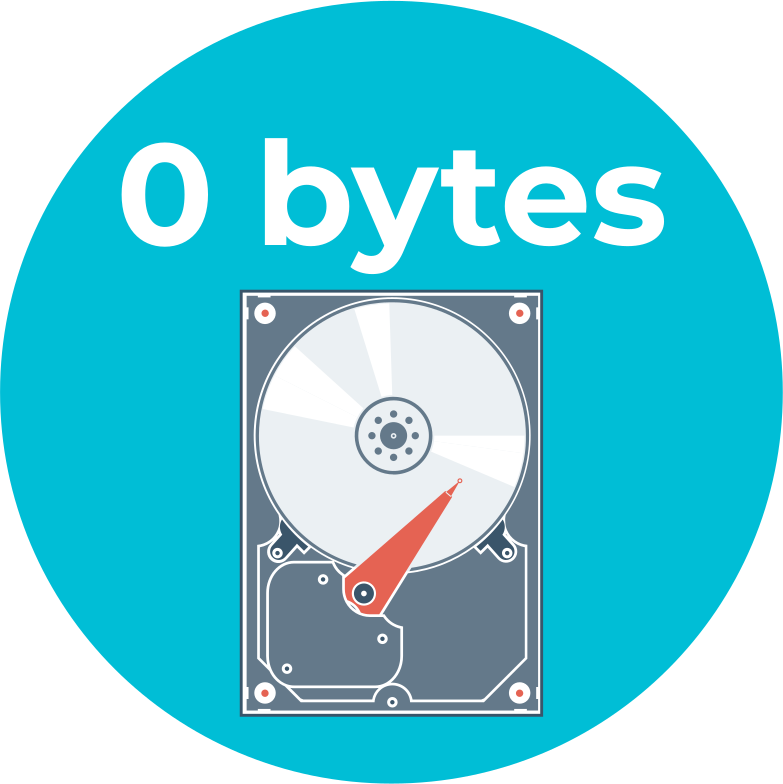
If your hard drive shows 0 bytes and want to know what to do, you have come to the right place. This article is dedicated to this problem and shows you how to get out of the trap quickly, efficiently and safely.
All solutions can be done even by beginners, not to mention more knowledgeable users.
To complete the picture, everything will be presented in order.
Reasons why HDDs may be showing 0 bytes
In principle, it is almost impossible to predict the problem of an external hard drive showing 0 bytes. But you can look at the factors that can lead to this error and continue to be careful.
This kind of error can occur due to a damaged hard disk, bad sectors, a downed file system, etc.
Sometimes, a person’s careless use of their computer can lead to disaster; for example, by removing an external hard drive in an unsafe way, interrupting disk formatting, suddenly shutting down the network, etc.
With that understanding, let’s proceed to fix the external hard drive shows 0 bytes problem.
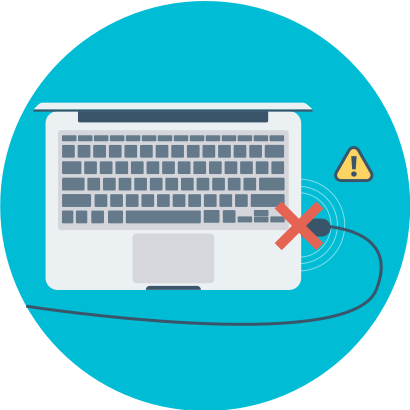
Method 1. Reconnect external hard drive
If this problem occurs on an external hard drive and not on you main internal hard drive (this can happen on a second internal drive), you can remove it.
After that, restart the computer and reconnect.
This should help with the problem of an external hard drive showing 0 bytes.
Method 2. Upgrade drivers
This method can be implemented in several ways. You can simply download the latest updates on the device’s developer’s website and install them using the Wizard or update the drivers yourself through the Device Manager.
In the latter case, right-click on Start and select Device Manager. Next, open all the drivers and right-click the problematic disk (the one that shows 0 bytes). Next, click on the Update list and then on “Automatically find driver updates”. Now press Enter and wait for the process to complete. Updates will also be installed automatically, but a reboot is required.
Finally, check the health of the disk.
Method 3. Get your data from the hard drive
If the previous methods were ineffective, you will have to resort to heavy artillery.
But for this you first need to restore or backup data from the disk using DiskInternals Partition Recovery, since the probability of losing data is extremely high. But with Partition Recovery, you have nothing to worry about, since you can use the full recovery mode and all files, without exception, will be found.
You can also use the reader mode and view files but without the possibility of editing them. The hard drive is always full of information, and the number of formats is endless, but Partition Recovery will restore any type of data, no matter the size. The program has both a free trial version and a full-featured one with data export to any portable or stationary medium. In both versions of the program, viewing files is completely free — this is for your protection and safety.
Start recovery as early as possible, as overwriting data can also hurt.
Method 4. Use CHKDSK to fix hard drive
The CHKDSK utility is very effective, but also harmful to recoverable data. Use it only after you get all your files back with Partition Recovery.
Press Win + X at the same time and select Command Prompt, where you need to type the following: “chkdsk E: /r /f”.
Note: E is the letter of the hard drive that shows 0 bytes.
r- tells the program to detect bad sectors on the disk and restore information that can be read.
f - tells CHKDSK to correct the errors found.
Press Enter and await the results. Now reboot the system.
Related articles
- What To Do If You Cannot Extend Volume in 2026
- Convert RAW to NTFS in 2 Steps!
- Сorrupted Hard Drive - What To Do Now?
- External hard drive repair software [2026]
- Guide: How to Fix a Corrupted Hard Drive Fast
- Hard disk detected as RAW? Perform RAW Drive Recovery!
- Hard Disk Recovery | DiskInternals Partition Recovery
- Hard Drive Repair and Bringing Files Back
- How to Fix a Corrupted External Hard Drive at Home in 2025
- How to Fix a Crashed Hard Drive on Your Own
- How to fix hard drives at home
- How to recover data from a damaged external hard disk
- How to Repair a Damaged Partition with Partition Recovery™
- How to Recover Data from a Formatted Hard Drive in 7 Steps (2025)
- Recover Files from Corrupted External Hard Drive Today!
- Recovering Data from Crashed Hard Drive: Safe
- Repairing of Corrupted Hard Drive
- Revive Your Laptop Hard Drive With Recovery Tips
- How to Recover Data from a RAW Hard Drive - Raw Partition Drive Recovery
- The best, most reliable software to recover files from a corrupted hard drive
- Repair a Hard Drive with Bad Sectors | Fix HDD Bad Sectors & Recover Data
- Disk is Write-Protected? Don't Give Up Yet!
- External hard drive not showing up? Fix it in 2025!
- New hard drive not showing up in Windows 10
- Seagate external HDD not showing up in Windows 10? Solved!
- External hard drive: Access is denied
- External hard drive having ‘the parameter is incorrect’
- Seagate external hard disk light blinking but not detecting
- WD HDD Repair Tool Guide: Western Digital Hard Drive Repair, Recovery & Fix 2026
- How to Fix: Windows Detected a Hard Disk Problem⠀
- OEM Partition and how to delete it safely
- Having hard drive error code 2000-0142? Fix it!
- Signs Your Hard Drive Is Failing in 2025
- How to repair SATA Hard Drive?⠀
- What causes lead to a hard drive fails?
- How to Recover Data from a Dead External Hard Drive and Repair It (2026)
- Solved 2025! Fix a dead external hard drive and restore files
- [Solved] How to get files off a broken laptop safe
- [Solved] Wiped vs accidentally erased hard drive
- [Solved!] External hard drive not detected
- Initialize a disk before the disk manager can access it
- [Error] The volume does not contain a recognized FS
- How you can initialize disk without losing data
- HDD Data Recovery from Unallocated Space
- [Windows] Recover an unallocated partition today
- Make Unallocated Space Into Free Space
- How to Unpartition an External or Internal Hard Drive
- If the Hard Drive Disappeared on Windows 10
- [SOLVED] How to Recover Files from a Hard Drive that Won't Boot
- Why the Hard Drive Clicking Happens and How to Fix It
- Couldn't Create a New Partition or Locate an Existing One
- Need to Install Windows 10 on the External HDD?
- If Hard Drive Short DST Check Failed
- How to fix ASUS motherboard not detecting SATA hard drive issue
- ReFS: can you use it for RAID
- If Windows 10, 11 doesn't recognize hard drive
- Recover lost.dir files android Device (2026)
- Not enough unallocated space on target disk
- How to delete an EFI System Partition
- Converting a dynamic disk to a basic disk
- How to use OneDrive
- Partition a hard drive on Windows 10
- Guide on how to activate partition
- How to check hard drive health?
- How to deal with smart hard disk error 301 on HP laptops?
- How to use Windows partition manager correctly
- Is it worth it to compress this drive to save disk space?
- Step-by-step guide on how to wipe a hard drive
- Moving hard drive to new computer
- Seagate hard drive beeping: your actions
- If the Unknown Hard Error message appears
- If you want to remove OneDrive
- If you get hard disk short DST failure
- Creating new simple volume: only workable tips
- How to use a hard drive reader
- This is how to combine partitions Windows 10
- Primary vs. Logical partition comparison
- How to Backup in Windows 10, 11?
- What to do in case of External Hard Drive I/O Error?
- Maxtor Hard Drive Recovery
- LaCie External Hard Drive Recovery
- Hard Drive Password Recovery: Everything You Need to Know
- Hard Disk 3f0 Boot Device Not Found on HP: Fix it Now!
- How to Recover a Wiped Hard Drive
- Partition Recovery Guide in pictures

