
What is a Bash Nested Loop?
If you constantly deal with bash scripts, you will obviously come in contact with many terms, commands, and techniques. Different bash commands can cause your script not to run as expected if not properly entered. In this article, you will learn more about nested loops in bash scripts: what a nested loop is, and how you can handle one when bash scripting. Quick note: it is possible to put multiple loops inside one another.
Here you will find out:
- what a nested loop is
- how a bash nested loop works and why it is useful
- when DiskInternals can help you
Are you ready? Let's read!
Nested loop definition
It is quite simple: a nested loop is an inner loop placed inside another one (loop). That is to say, it is a loop that exists inside an outer loop. When you integrate nested loops in bash scripting, you are trying to make a command run inside another command. This is what it means: a bash nested for loop statement runs a command within another loop.
How does it work?
When you have a nested loop, here is what happens: the outer loop triggers a command, and the nested (inner) loop executes the command to complete. Each time the main loop (i.e., the outer loop) is triggered, it also triggers the inner loop, and this process continues in this manner until the outer loop stops running. However, if the outer or inner loop breaks within the running time, the process will be interrupted.
Why is a nested loop useful?
Literally, every programming command is handy for a particular purpose. A nested loop is useful because it allows the programmer to use the best attributes of any type of loop, including the while loop and for loop.
There's no specific number of nested loops you can have inside another loop; however, the indentations will become very complicated to track as the number of nested loops keep increasing.
Example of a bash nested for loop
Below is how you can successfully nest a for loop inside another loop.
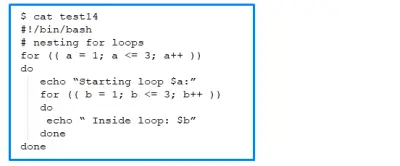
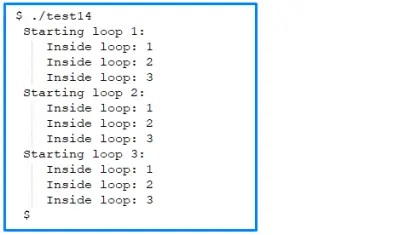
The nested loop, or inner loop, will run repeatedly through its values for each time the outer loop is triggered. Also, there is usually no difference between the “do” and “done” commands for both loops. Bash recognizes when the first commands are successfully executed; then, it refers to the inner loop to continue, while leaving the outer loop alone.
This same process applies when you nest a for loop inside a while loop.
It’s easy to open Linux files in Windows
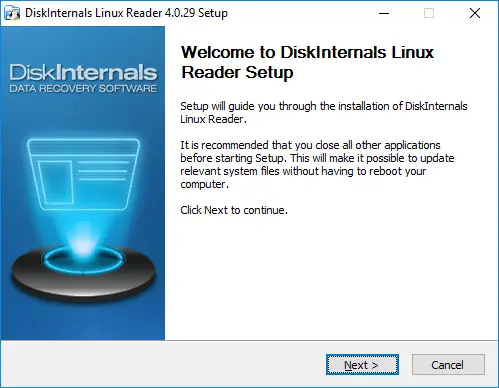
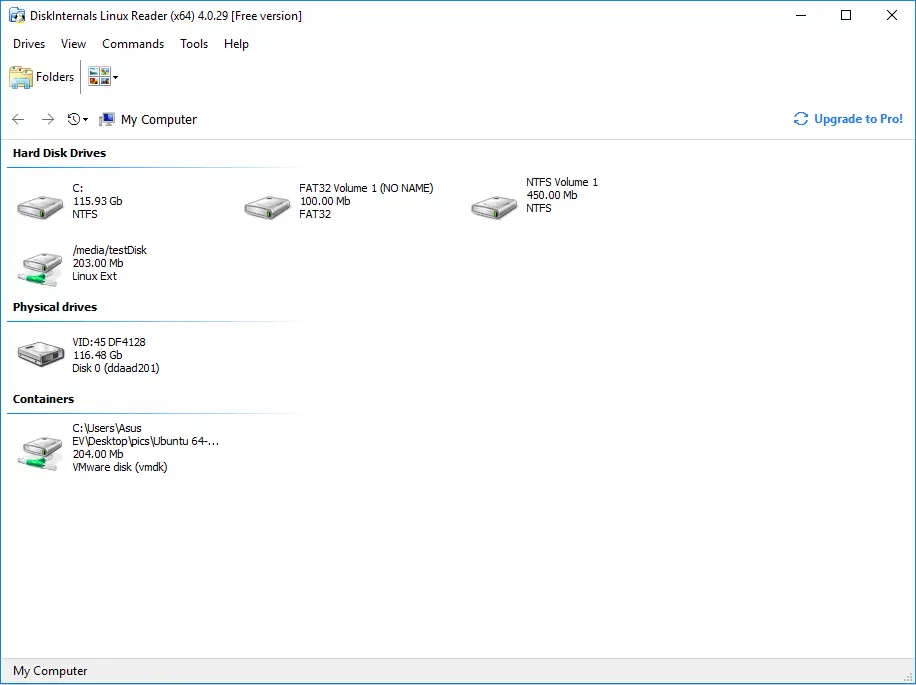
Using DiskInternals Linux Reader, it is possible to open your Linux files on Windows computers. DiskInternals Linux Reader is arguably the best and most intuitive software app that lets you access and view files saved on Ext2/3/4 partitions on a dual-boot Windows PC or virtual machine. It features an easy-to-read interface where you can easily navigate and explore the features it has to offer. More interestingly, DiskInternals Linux Reader is available for free.
Related articles
- About a bash date command
- How to Access Linux Ext2 or Ext3 on Windows
- How to Access Ext4 from Windows
- How to Mount Ext4 on Windows for Free
- Mount Linux Drive on Windows for Free
- Bash Script: All You Need to Know
- An Algorithm: How to Create Bash While Loop
- Linux Shell: What You Need to Know at First
- 5 Basic Shell Script Examples for Your First Script
- Bash: How to Check if the File Does Not Exist
- Bash Time Command on Linux
- How to use bash get script directory in Linux
- How to Check Bash String Equality
- How to Use Linux Wait Command
- Bash: How to Loop Through Files in Directory
- 20 Examples of Bash Find Command
- Bash Cat Command in Examples
- Bash Script SSH: How to Use It
- Bash: A Script For User Input
- Linux ZSH: the basic you need to know
- Basic of Grep in Linux Shell Script
- Shell Script Cut: Basic You Need to Know
- Bash: How to Check if String Not Empty in Linux
- Bash: how to split strings in Linux
- Linux: Sudo in Bash Scripts
- Hello World Script in Bash
- A Linux bin/bash Shell
- Linux: New Line in Shell Script
- Linux: Bash String Ends With
- Linux: Bash Printf Examples
- Linux: Bash First Line
- Linux: $0 in a Shell Script
- Linux: A Bash Startup Script
- Linux: Write a Shell Script
- Shell Script: Replace String in File
- A crontab service shell script
- Bash and sh: is there any difference
- A Bash Dirname Command
- Linux: A Bash Source Command
- A Bash to Loop through Lines in File
- Linux: A Bash Linter
- A Bash Test Command
- Use a Shell Script to Send an Email
- A Bash Status of Last Command
- Linux: A Bash Basename Command
- Using Bash to Write to a File
- About Bash Language
- Bash for Loop in One Line
- AWK in a Bash Script
- Learn about useful bash scripts
- Learn about systemd startup script
- About chaining bash commands
- Learn about a bash error code
- Using a bash tee command
- About a bash export command
- Learn about a bash wait command
- Arch Linux install script
- About advanced bash scripting
- To run a shell script in Dockerfile
- About a bash UNTIL loop
- Learn about C shell script
- Learn about Korn shell scripting
- Using /usr/bin/env command
- Whether bash waits for command to finish
- Using bash if 0
- Using && in an IF statement in bash
- If you want to run shell script in background
- The disk you inserted was not readable by this computer error
- Learn about SFTP in bash scripting
- Learn to run Perl script in Linux
- Examples of using the Expect
- Copy command in shell scripts
- Shell script usage
- Install Oracle Database
- Here is everything you need to know about Bash for Windows
- Guide in Pictures
- How to Use Shell Script Sleep Command
- A Bash Multiline Command