
How to Loop Through Files in Directory
There are quite a lot of things you may not know about Linux’s Bash scripts. However, this article can show how you can automate actions on multiple files using loops and find commands. If you’re using a Linux shell, you definitely need to know a lot about Bash scripts and how to use them to satisfy your needs.
Here you will find out:
- can I use Bash loop through files in a directory?
- how to use Bash loop through files
- when DiskInternals can help you
Are you ready? Let's read!
Can you use Bash loop through files in a directory?
Yes, you can loop through files in a directory.
The command is quite simple and easy to understand. Using the For loop, you will instruct your computer to take specific actions for each file it processes. However, you will have to specify the files for your computer to understand; thus, you can use Bash’s For loop to instruct your computer to run specific actions for all files in a particular directory.
A basic loop
A basic loop, or classic look as it is called by most people, is a simple loop that allows you to test your capability of handling individual files in a directory. It is advisable that you create a test directory and copy some files into this new “test” directory, then try using the basic loop command to run the files individually.
Bash loop through files
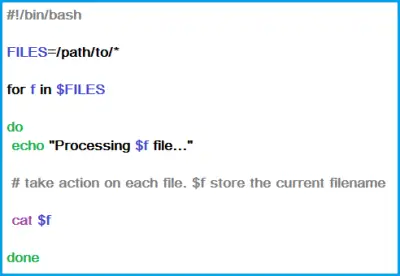
In order to use Bash to loop through files, first create a variable “f,” then specify the data set it will go through. Also, define the directory or use the * wildcard character for your current directory, after which you will introduce a semicolon (;). Then you’ll have something like the example below;

Using the file command (f variable), specify what action should take place each time the loop repeats itself.
Need an explorer for Linux files on Windows?
Exclusive for people who use virtual machines or dual-boot on a computer, DiskInternals Linux Reader is a handy freeware program that allows users access to view Ext2/3/4 partitions on Windows. It is an intuitive utility for everyone who runs Linux and Windows on the same computer.
Even so, DiskInternals Linux Reader does not make use of any algorithm, and its interface is very easy to understand because it mimics the Windows Explorer interface.
Related articles
- How to Access Linux Ext2 or Ext3 on Windows
- How to Access Ext4 from Windows
- How to Mount Ext4 on Windows for Free
- Mount Linux Drive on Windows for Free
- Bash Script: All You Need to Know
- An Algorithm: How to Create Bash While Loop
- Linux Shell: What You Need to Know at First
- How to Use Shell Script Sleep Command
- Bash: How to Check if the File Does Not Exist
- How to use bash get script directory in Linux
- 20 Examples of Bash Find Command
- Shell Script Cut: Basic You Need to Know
- Bash: How to Check if String Not Empty in Linux
- Linux: Sudo in Bash Scripts
- Linux: Bash Printf Examples
- Linux: Bash First Line
- Linux: A Bash Startup Script
- Linux: Write a Shell Script
- Shell Script: Replace String in File
- Bash and sh: is there any difference
- A Bash Dirname Command
- Linux: A Bash Source Command
- A Bash to Loop through Lines in File
- A Bash Nested Loop
- Use a Shell Script to Send an Email
- Using Bash to Write to a File
- About Bash Language
- Bash for Loop in One Line
- Learn about useful bash scripts
- About chaining bash commands
- About a bash export command
- Learn about a bash wait command
- Arch Linux install script
- About advanced bash scripting
- Learn about C shell script
- Learn about Korn shell scripting
- Using && in an IF statement in bash
- If you want to run shell script in background
- The disk you inserted was not readable by this computer error
- Learn about SFTP in bash scripting
- Copy command in shell scripts
- Install Oracle Database
- About a bash date command
- Guide in Pictures
- 5 Basic Shell Script Examples for Your First Script
- Bash Time Command on Linux
- How to Check Bash String Equality
- How to Use Linux Wait Command
- Bash Cat Command in Examples
- Bash Script SSH: How to Use It
- Bash: A Script For User Input
- Linux ZSH: the basic you need to know
- Basic of Grep in Linux Shell Script
- Bash: how to split strings in Linux
- Hello World Script in Bash
- A Linux bin/bash Shell
- Linux: New Line in Shell Script
- Linux: Bash String Ends With
- Linux: $0 in a Shell Script
- A crontab service shell script
- A Bash Multiline Command
- Linux: A Bash Linter
- A Bash Test Command
- A Bash Status of Last Command
- Linux: A Bash Basename Command
- AWK in a Bash Script
- Learn about systemd startup script
- Learn about a bash error code
- Using a bash tee command
- To run a shell script in Dockerfile
- About a bash UNTIL loop
- Using /usr/bin/env command
- Whether bash waits for command to finish
- Using bash if 0
- Learn to run Perl script in Linux
- Examples of using the Expect
- Shell script usage
- Here is everything you need to know about Bash for Windows